
308,700 projected openings: the scale of general and operations management
BLS projects 308,700 openings a year for general and operations managers. See what the figure measures, who it includes, and what candidates need to prove.
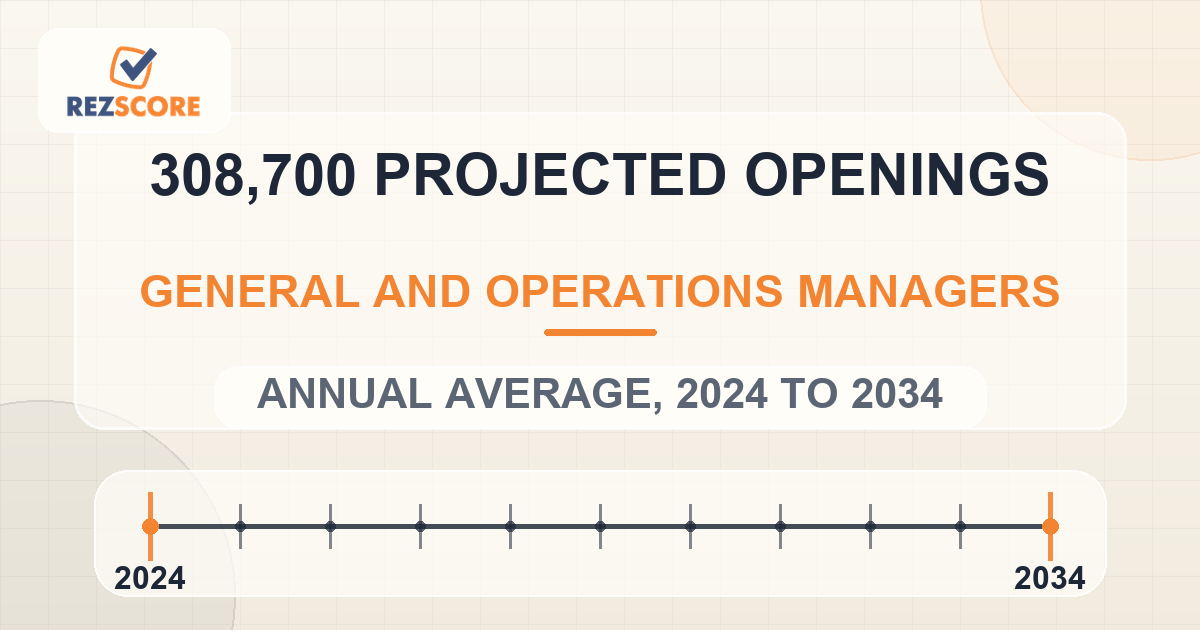
The Bureau of Labor Statistics projects an average of 308,700 openings a year for general and operations managers from 2024 through 2034. That is the highest annual opening count among the 178 detailed occupations BLS classifies as typically requiring a bachelor’s degree for entry.
The figure is a projection averaged across ten years. Current vacancies and newly created jobs are different measures.
What does 308,700 projected openings mean?
BLS occupational openings measure opportunities for people entering an occupation. They combine net employment growth with openings created when workers permanently leave that occupation.
The underlying BLS table makes the calculation visible:
| Measure | BLS projection |
|---|---|
| General and operations managers employed in 2024 | 3,712,900 |
| Projected employment in 2034 | 3,876,800 |
| Net employment change across the decade | 164,000 |
| Average labor force exits each year | 87,900 |
| Average transfers to other occupations each year | 204,500 |
| Average occupational openings each year | 308,700 |
Projected employment grows by 164,000 across the decade, or an average of 16,400 positions a year. BLS also projects 292,300 annual occupational separations. Add those two components and the result is 308,700 projected openings a year.
An occupational separation has a narrower meaning than ordinary turnover. It includes someone leaving the labor force or transferring to a different occupation. It does not include a general manager who changes employers and remains a general manager. BLS explains the distinction in its occupational separations methodology.
Current vacancy counts answer another question. The Job Openings and Labor Turnover Survey measures unfilled positions on the last business day of a month. The 308,700 projection estimates opportunities for people entering the occupation, averaged over a decade.
BLS recommends using these projections to understand scale and compare occupations. It also warns against treating the annual average as a precise target for any individual year.
Who counts as a general and operations manager?
This occupational category is broader than one job title. O*NET describes the work as planning, directing, or coordinating the operations of public or private organizations, often across multiple departments or locations.
Its sample titles include business manager, center manager, department manager, district manager, general manager, operations director, operations manager, plant superintendent, and store manager.
The boundary matters. O*NET says people in this occupation usually manage through subordinate supervisors, and it explicitly excludes first-line supervisors. A shift supervisor and a regional operations manager may both coordinate people and schedules, but the federal taxonomy does not treat them as the same occupation.
Titles alone will not settle the question. An “operations manager” at a small office may have less authority than a department manager at a hospital or a general manager overseeing several retail locations. The work, span, and level of decision-making define the role more reliably than the label.
This is a large market for experienced workers
BLS lists a bachelor’s degree as the typical entry education and five years or more of related work experience as typical preparation. The occupation’s 2024 median annual wage was $102,950. Median means half of workers earned more and half earned less. It does not describe every location, industry, title, or offer.
The experience requirement shapes the market. A large opening count does not make a move into management easy. BLS classifies five years or more of related experience as typical preparation, so candidates need to show that they have already handled some part of the work.
Indeed Hiring Lab supplies broader context. It found that senior-level postings were up 13.5 percent from January 2025 to May 2026, while mid-level postings were down 6.7 percent. Senior roles still represented only about 14 percent of postings nationwide, compared with 40 percent for mid-level roles and 46 percent for entry-level roles.
Indeed classifies seniority from responsibilities and required preparation rather than titles alone. Its data covers the wider labor market, so it does not prove an operations-specific shift. Senior roles were growing fastest, but they remained a minority of postings.
What does operations-management work ask you to prove?
O*NET’s task list turns a broad occupation into concrete areas of responsibility. General and operations managers review performance data, coordinate business or departmental activity, assign staff work, direct budgets, work across departments, handle personnel functions, establish policies, and monitor suppliers.
For a candidate, those responsibilities translate into five kinds of evidence:
- People: team size, staffing coverage, hiring, training, evaluation, and the level of supervision.
- Money: budget, purchasing authority, cost controls, and financial tradeoffs.
- Operating span: locations, departments, schedules, production volume, service volume, or territory.
- Decisions: policies, priorities, escalations, vendor choices, and resource allocation.
- Results: productivity, cost, quality, safety, service levels, customer outcomes, or employee outcomes.
A resume can lose useful information here. “Managed schedules” names an activity. “Owned weekly staffing coverage for 28 employees across three locations” shows the scale of that activity. A result can make the line stronger when the candidate actually measured one. An invented percentage makes it weaker.
The goal is to give the reader enough context to judge the level at which the work happened without making routine work sound executive. Our guide to quantifying a resume when you do not have revenue numbers covers several honest ways to show scope. The distinction between responsibilities and achievements helps separate what the job assigned from what changed because you did it well.
How should a candidate use this market data?
The 308,700 figure shows that people enter general and operations management at a large scale. It does not tell you which title fits, whether your experience meets a particular opening, or how many other candidates will apply. BLS does not project the supply of workers, so the number cannot establish a labor shortage or an easy path to an offer.
Start with the work you can substantiate. Inventory the people, money, operating span, decisions, and results you have owned. Then compare that evidence with a narrow group of openings whose responsibilities overlap.
A candidate who has already scheduled staff, trained colleagues, allocated resources, handled escalations, coordinated vendors, or changed a process may have management-shaped experience under another title.
Grade your resume free to see whether your current document shows specific evidence or mainly lists responsibilities.
Sources
- Bureau of Labor Statistics, projected job openings in occupations typically requiring a bachelor’s degree, 2024 to 2034
- Bureau of Labor Statistics, occupational separations and openings table
- Bureau of Labor Statistics, occupational separations methodology FAQ
- Indeed Hiring Lab, The Labor Market Is Tilting Toward Seniority
- O*NET, General and Operations Managers
See how your resume actually scores.
Grade my resume - freeTry the free resume grader to see your resume score in seconds.
← All posts