
Prompt engineering jobs in 2026: skill yes, title no
Prompt engineering pays well but rarely appears as a job title. What January 2026 posting data and the July 2026 AI math results mean for your career.
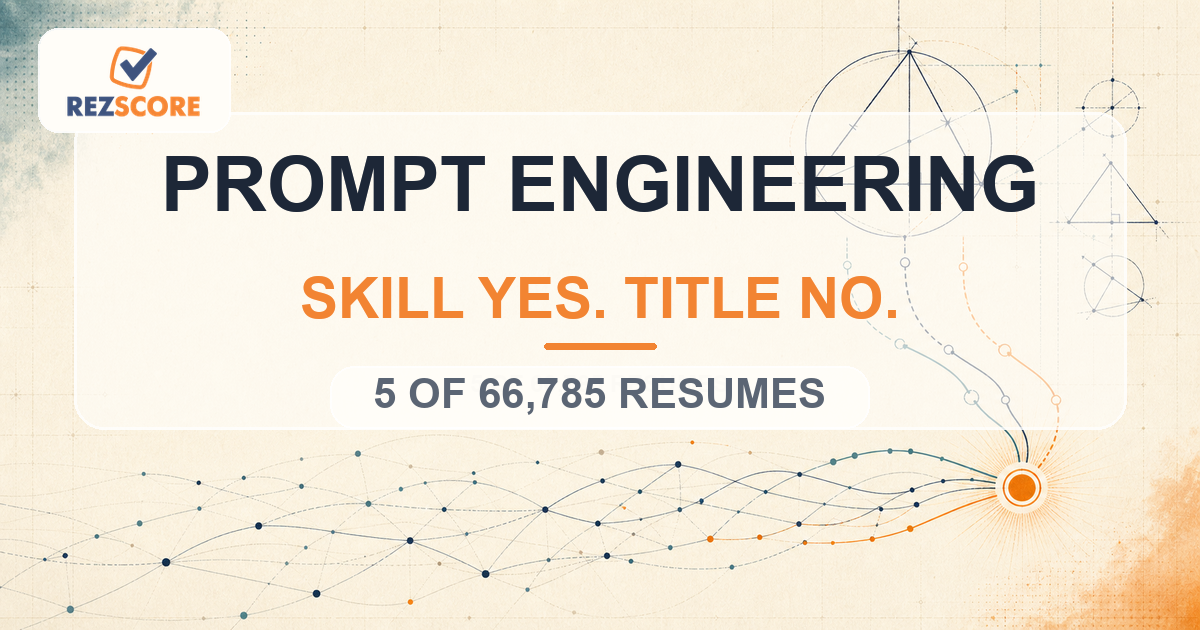
Is prompt engineering a real career in 2026? As a standalone job title, barely. In RezScore’s January 2026 analysis of US job postings, 7,359 postings mentioned prompt engineering while 140,068 matched Software Engineer, and only five of 66,785 resumes in our database listed Prompt Engineer as an actual title. As a skill inside another profession, the picture is the opposite: prompting is becoming more valuable, and the July 2026 wave of AI-assisted mathematics is the clearest demonstration yet of why. The sensible move is to learn to prompt, verify, and integrate AI into real work, then attach that skill to a durable profession instead of chasing the title.
The week “just prompt it” became a math meme
On the weekend of July 19 to 20, 2026, mathematician Levent Alpöge (who works at Anthropic and is a Junior Fellow of the Harvard Society of Fellows) announced on 𝕏 an explicit counterexample to the Jacobian Conjecture, a problem that had been open since 1939. He credited Akhil Mathew, a University of Chicago mathematician, with suggesting the problem, and Fable, an AI model from Anthropic, with finding the example.
In plain English: the conjecture concerned polynomial maps, which are recipes that turn a set of input numbers into a set of output numbers using only multiplication and addition. Each map has a Jacobian determinant, a quantity that measures how the map stretches space near a point. The conjecture said that if this determinant is a constant that is not zero, the map should never send two different inputs to the same output. The new three-variable example does exactly that: constant nonzero determinant, yet distinct inputs land on the same output. That refutes the conjecture in dimensions three and higher. The two-dimensional case remains open.
What made the announcement land was checkability. The example is short enough to verify directly, and mathematicians did so within about a day. It was also formalized in Lean, a proof assistant that mechanically checks every logical step. Terence Tao published an explanation on July 21 and disclosed that he “used an AI chatbot to discuss various aspects of this problem and to confirm several of the calculations.” Kevin Buzzard titled his write-up “Human mathematicians are being outcounterexampled” and concluded that “Large AI-generated developments of mathematics are inevitable.”
It was not an isolated event. In May 2026, an OpenAI reasoning model disproved a longstanding Erdős conjecture about unit distances, and nine external mathematicians published a human-checked version. A July 20 paper gave explicit counterexamples to the Gaussian Moments Conjecture and disclosed in the text that both ChatGPT and Claude Fable contributed to the search. The lesson is not to trust every viral claim: a screenshot is not a proof. Public artifacts and independent checking are what make a result worth using.
So the meme wrote itself: a decades-old conjecture fell, and the visible artifact was a short post on 𝕏. “Just prompt it” became the joke. The joke is worth taking seriously, but not literally.
Short answer: Is prompt engineering a real career?
Short answer: Prompt engineering is a real and increasingly valuable skill, but a rare standalone job. In RezScore’s January 2026 posting data, prompt engineering appeared in 7,359 US postings (about 5.4 percent of Python’s 137,176) at a $164,840 average advertised salary, and only five of 66,785 resumes listed Prompt Engineer as a title. Learn the skill. Attach it to a profession.
What did the July 2026 math breakthroughs actually demonstrate?
Not that anyone with a chat window can topple famous conjectures. The honest reading is narrower and more useful.
Frontier models demonstrated that they can search enormous spaces of candidate ideas, propose concrete constructions, carry out calculations, and connect distant areas of mathematics, especially where the output can be rigorously checked. A counterexample is the friendliest possible format for a machine: once found, anyone can verify it by direct computation, and a proof assistant like Lean can certify it mechanically.
Humans did everything around that core. Akhil Mathew selected a problem worth attacking. Alpöge ran the collaboration and staked his name on the announcement. Independent mathematicians verified the result within a day. Tao explained what the example means and where understanding is still missing. The Gaussian Moments paper is explicit about the division of labor: after disclosing exactly what each AI model contributed, the author writes that “The human author bears full responsibility for the mathematics.”
That is the emerging collaboration model: machines generate and calculate at scale, humans choose the target, check the output, interpret it, and answer for it. Neither half works alone.
Why do short prompts sometimes work in mathematics?
Three ingredients make mathematics unusually prompt-friendly, and none of them transfers automatically to your job.
Verifiability. A counterexample is checkable by computation. Notably, OpenAI’s own account of the unit-distance result says the proof was generated “in one shot by an internal model” and then refined by humans. One-shot generation is tolerable precisely because verification is airtight. If your work product cannot be checked that rigorously (most business work cannot), you need more human review, not less.
Expert steering. The problems were chosen by people who knew which questions were both important and plausibly within reach. A well-chosen problem is most of the value. Tao’s one-sentence AI disclosure describes discussion and confirmation of calculations, which is expert usage, not magic.
Iteration. Depending on one response is a weak production method. Keep an audit trail, test promising directions, and budget enough time to reject plausible-looking failures.
The transferable lesson: prompting pays off most where outputs can be verified, where an expert picks the target, and where you can afford many attempts. Knowing what can be checked may be the most important prompting skill there is.
Is “Prompt Engineer” a real job title?
Rarely. Our January 2026 analysis of US job postings (collected via the Adzuna API) found 7,359 postings mentioning prompt engineering. For scale, 137,176 mentioned Python and 140,068 matched Software Engineer. Prompt engineering demand ran at roughly 5.4 percent of Python demand.
The resume side is starker. Of 66,785 resumes we analyzed, five listed Prompt Engineer as an actual job title. Employers mostly are not hiring for the title, and workers mostly are not claiming it.
The salary signal points the same way. Among the subset of postings that included usable salary information, the average advertised salary for prompt-engineering postings was $164,840. High pay plus a tiny market is the signature of a premium add-on skill, not a mass occupation. Companies pay well for people who can do something else at a professional level and also drive AI effectively.
All of these are January 2026 figures, not real-time counts. We have kept the date visible on purpose.
Prompt engineering: skill versus job title
| Question | As a job title | As a skill inside a profession |
|---|---|---|
| Posting volume (Jan 2026) | 7,359 mentions | Hard to count; AI-tool expectations now appear across engineering, marketing, research, and operations postings |
| Evidence on resumes (Jan 2026) | 5 of 66,785 resumes | Best shown as outcomes inside your real role, not as a title |
| Pay signal | $164,840 average advertised salary in the subset of postings listing salary | Premium attaches to domain skill plus AI leverage |
| Durability | Uncertain; titles tied to one tool era age badly | Strong; verification and domain judgment transfer as models change |
| Our advice | Do not bet a career on the title | Learn it deliberately and pair it with a durable field |
Which careers benefit most from prompt engineering?
The skill compounds wherever iteration is cheap and verification is possible. Practical pairings:
- Software engineering. Code is testable, so AI output can be checked mechanically. This is the closest analogue to the math story.
- Mathematics, science, and research. Literature search, calculation checking, and candidate generation, with the researcher owning verification.
- Operations. Workflow automation and drafting, with measurable cycle-time outcomes.
- Marketing and content. Fast variant generation, with performance data as the check.
- Law, finance, and healthcare. High value and high stakes: AI drafts and summarizes, but professional review is the product, and regulated accuracy keeps humans central.
- Design. Rapid exploration of directions, with taste and user testing as the filter.
In each case the pattern is the same: the profession supplies the problems and the verification, prompting supplies the leverage.
How do you show AI skill on a resume without sounding unserious?
“Expert prompt engineer” on a resume reads like “expert Googler.” Describe the work, not the tool worship. A strong bullet names the problem, the workflow you built, how outputs were validated, and the measured result:
“Built an AI-assisted research workflow that reduced [task] from [baseline] to [result], with [human review or verification method].”
Fill that in with your real numbers or leave it out; an invented metric is worse than none, which is also why AI resume builders make things up when left unsupervised. The verification clause is what separates a serious candidate from a tourist. Anyone can generate output. Hiring managers want the person who knows whether the output is right.
If you want a read on how your current resume presents these skills, the free resume grader will grade it in seconds, and our Skills Explorer shows how to present specific technical skills with evidence.
What should you learn beyond clever prompts?
Prompting is the cheap part. The compounding skills around it:
- Verification. Testing, spot-checking against ground truth, and knowing when a plausible answer is wrong. The math results were credible because checking was airtight.
- Problem selection. Choosing tasks where AI leverage is real and failure is affordable.
- Domain depth. The expert in the loop was the point of every July story. Depth is what makes your prompts good and your checks meaningful.
- Workflow design. Turning one-off wins into repeatable processes with review steps.
- Measurement. Baselines and results, because “we use AI now” is not an outcome.
Our broader 2026 job-market study found the same shape across AI skills generally: they pay best as amplifiers of an existing profession.
Methodology and sourcing
Job-posting figures come from RezScore’s January 2026 analysis of US postings collected via the Adzuna API; counts are keyword and title matches in posting text, so they overlap and are not unique open jobs. Salary averages use only the subset of postings with usable salary data. Resume-title counts come from a 66,785-resume sample of RezScore’s database. Posting counts measure advertised demand, not employment, and are a dated snapshot: January 2026. Mathematical claims are sourced to the primary write-ups listed below.
FAQs
Is prompt engineering dead in 2026? No, but the standalone job barely exists and never grew large. In January 2026 US posting data, 7,359 postings mentioned prompt engineering versus 140,068 matching Software Engineer. The skill itself is more valuable than ever, as the July 2026 AI-assisted mathematics results showed, but it delivers value inside other professions rather than as its own occupation.
What does a prompt engineer earn? Among January 2026 US postings that mentioned prompt engineering and included usable salary information, the average advertised salary was $164,840. Treat that as a signal about a small, senior-skewed posting pool, not a typical offer for someone whose only skill is prompting.
Did AI really solve a famous math problem with one prompt? An AI model (Fable, from Anthropic) found an explicit counterexample to the Jacobian Conjecture in July 2026, and OpenAI reported a model disproved an Erdős unit-distance conjecture in May 2026, in that case generated in one shot. But mathematicians selected the problems, checked and formalized results, and interpreted them. The one-line prompt is only the visible part of an expert workflow.
Should I put “prompt engineering” on my resume? Name it only as part of a concrete achievement: the problem, the AI-assisted workflow, the validation method, and the measured outcome. A skills-list entry with no evidence reads as filler and can hurt more than help. Never invent the metric.
Is prompt engineering still worth learning in 2026? Yes, framed correctly: learn to direct, verify, and integrate AI within a field you are serious about. Verification skill and domain depth transfer as models change. A title tied to one tool era may not.
Sources
- Levent Alpöge’s announcement post on 𝕏, July 20, 2026: announcement of the counterexample; credits to Akhil Mathew (suggesting the problem) and Fable (finding the example).
- Terence Tao, “A digestion of the Jacobian conjecture counterexample”, July 21, 2026: three-dimensional counterexample with constant Jacobian determinant, an open two-dimensional case, and Tao’s AI-use disclosure.
- Kevin Buzzard, “Human mathematicians are being outcounterexampled”, July 20, 2026: Lean formalization details, including a manual formalization submitted to DeepMind’s Formal Conjectures repository.
- David Speyer, “The new counterexample to the Jacobian conjecture”, July 20, 2026: an independent write-up and direct verification.
- Christopher D. Long, “Small Counterexamples to the Gaussian Moments Conjecture”, July 20, 2026: explicit counterexamples and an AI-provenance section disclosing ChatGPT and Claude Fable contributions.
- OpenAI’s unit-distance announcement and the accompanying Remarks on the Disproof of the Unit Distance Conjecture: one-shot generation disclosure and external mathematical checking.
- RezScore, “The 2026 Job Market: What the Data Actually Shows”, January 2026: all posting counts, the $164,840 salary figure, and the five-resume title count.
See how your resume actually scores.
Grade my resume - freeTry the free resume grader to see your resume score in seconds.
← All posts