
The 2026 Job Market: What the Data Actually Shows
We analyzed real job postings. The results contradict almost everything you've heard.
We analyzed real job postings. The results contradict almost everything you’ve heard.
Everyone’s talking about how AI is changing the job market. Most of it is hype, speculation, or recycled takes from people who haven’t looked at actual data.
We did look at the data. Using the Adzuna API, we analyzed current job postings across the US market. The results challenge conventional wisdom on almost every front.
View our methodology and run the analysis yourself →
The “Prompt Engineer” Myth
Let’s start with the skill everyone’s talking about.
“Prompt Engineering” job postings: 7,359
That’s it. Out of millions of job postings, fewer than 8,000 mention prompt engineering.
For comparison: - Python: 137,176 jobs - Software Engineer: 140,068 jobs - Machine Learning: 77,214 jobs
Prompt engineering represents 5.4% of Python demand. It’s not a career path—it’s a nice-to-have skill.
But here’s what’s really interesting: prompt engineering pays $164,840 on average. High salary, tiny market. That’s the signature of a skill that’s valuable as an add-on, not as a primary job function.
What About “Prompt Engineer” as a Job Title?
We also searched our database of 66,785 resumes. How many people list “Prompt Engineer” as their actual job title?
5 people. That’s 0.01%.
The job barely exists. Most AI skills appear as additions to existing roles—not new careers.
The Skills That Actually Pay
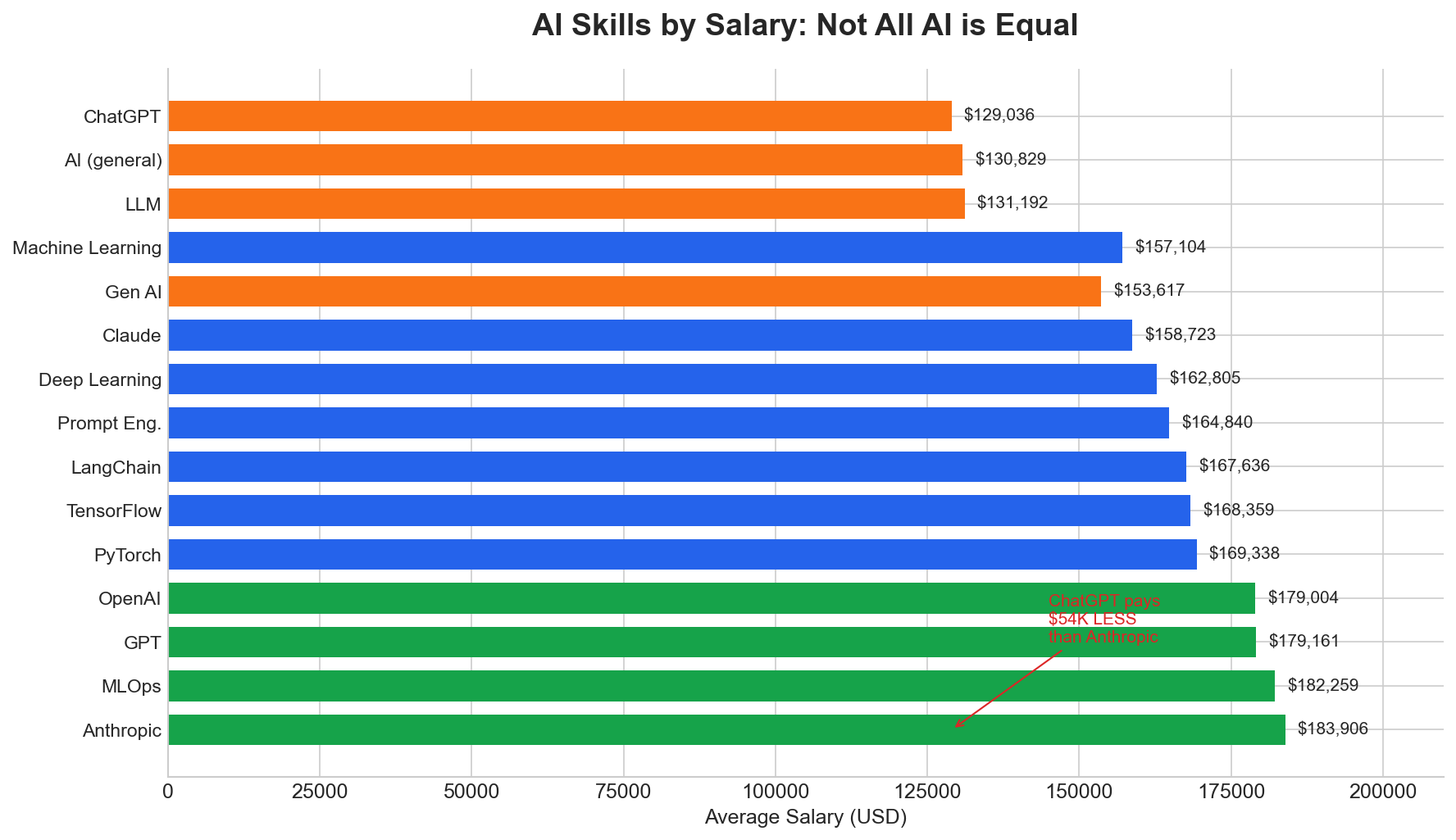
We ranked AI-related skills by average salary. The results might surprise you:
| Skill | Avg Salary | Job Count |
|---|---|---|
| Anthropic | $183,906 | 2,331 |
| MLOps | $182,259 | 7,069 |
| GPT | $179,161 | 3,264 |
| OpenAI | $179,004 | 6,446 |
| PyTorch | $169,338 | 14,712 |
| LangChain | $167,636 | 6,298 |
| Prompt Engineering | $164,840 | 7,359 |
| Claude | $158,723 | 4,611 |
| Machine Learning | $157,104 | 77,214 |
| ChatGPT | $129,036 | 3,670 |
ChatGPT is at the bottom. Jobs mentioning ChatGPT pay $54,870 less than jobs mentioning Anthropic.
Why? Because “I know ChatGPT” is table stakes. Everyone knows ChatGPT. The premium goes to people who understand the deeper stack—MLOps, specific frameworks, deployment infrastructure.
Enterprise Tech Still Wins
Here’s something the tech media never talks about:
| Technology | Job Postings |
|---|---|
| Oracle | 109,718 |
| Workday | 100,213 |
| SAP | 62,972 |
| Salesforce | 61,982 |
| React | 48,477 |
Boring enterprise software has more job openings than the trendy frameworks. Oracle alone has more than double the job postings of React.
These aren’t glamorous skills. They won’t get you Twitter followers. But they will get you employed.
What Actually Died (And What Didn’t)
Remember when everyone was talking about Web3, NFTs, and the metaverse?
| Technology | Job Postings | Salary |
|---|---|---|
| NFT | 287 | $143,368 |
| Metaverse | 254 | $152,752 |
NFT and Metaverse are dead. Under 300 job postings each. The hype cycle is over.
But crypto infrastructure? Very much alive:
| Technology | Job Postings | Salary |
|---|---|---|
| DeFi | 4,789 | $100,985 |
| Ethereum | 4,417 | $176,465 |
| Stablecoin | 1,424 | $177,667 |
| Smart Contract | 1,401 | $169,322 |
| Crypto Trading | 1,269 | $187,087 |
The speculative stuff (NFTs, metaverse) collapsed. The financial infrastructure (stablecoins, DeFi, smart contracts) pays $170K+ and is hiring.
Meanwhile, COBOL—the language everyone’s been declaring dead for 30 years—still has 896 job postings at $131,671 average salary. That’s comparable to Flutter ($131,805 with 1,458 jobs).
The Degree Myth
| Requirement | Job Postings | Avg Salary |
|---|---|---|
| “No degree required” | 464,890 | $101,638 |
| “Computer science degree” | 96,375 | $148,840 |
Five times more jobs say “no degree required” than explicitly require a CS degree.
Yes, the CS degree jobs pay more. But the sheer volume of “no degree” jobs suggests the market is more accessible than conventional wisdom claims.
The Remote Work Reality
| Work Arrangement | Job Postings |
|---|---|
| On-site | 1,044,536 |
| Work from home | 566,965 |
| Hybrid | 272,529 |
| Remote only | 15,755 |
“Remote only” is rare. Only 15,755 job postings explicitly offer fully remote positions.
The return-to-office trend is real. On-site positions outnumber remote-only by 66:1.
What AI Actually Means for Jobs
Here’s the take nobody wants to hear:
Software engineers won’t be mass-replaced by AI.
Why? Because companies aren’t going to fire their engineers. They’re going to greenlight more projects.
That internal analytics dashboard you previously set aside because it would add a month to development? Now it takes an hour. The automation that was “nice to have” but never prioritized? Now it’s feasible.
AI doesn’t eliminate work—it eliminates the excuse for not doing work.
The Top 1% Get Superpowers
The real impact of AI isn’t job replacement. It’s amplification.
- 100x engineers become 1000x engineers
- Solopreneurs outcompete laggard companies with entire teams
- The gap between “good” and “exceptional” widens dramatically
AI turbocharges the people who embrace it. It’s only a problem for those who refuse to adapt—and they were already falling behind.
The earliest AI adopters? Overwhelmingly the top performers. The same people who were always learning, always iterating, always pushing. AI just gave them better tools.
The Real Action Items
Based on actual data, here’s what matters:
1. Stop Chasing Hype Titles
“Prompt Engineer” is not a career. It’s a skill you add to an existing career. The jobs that actually exist are: software engineer, data engineer, ML engineer, DevOps engineer.
2. Learn the Boring Stuff
Oracle, SAP, Salesforce, Workday—these aren’t sexy, but they have massive job markets. If you want job security, enterprise tech delivers.
3. Go Deeper, Not Wider
ChatGPT pays $129K. Anthropic pays $184K. The difference is depth. Anyone can use ChatGPT. Fewer people understand why Claude might be better for certain tasks, or how to deploy LLMs at scale with LangChain.
4. Skills > Credentials
The “no degree required” market is 5x larger than the “degree required” market. What you can do matters more than where you learned it.
5. Embrace AI or Fall Behind
This isn’t optional. 65% of job seekers are already using AI. If you’re not, you’re in the bottom third by default.
Check Where You Stand
Curious how your skills map to market demand?
We’ll analyze your resume against current job market data and show you: - Which of your skills are trending up or down - Salary ranges for your skill combination - Gaps between your profile and high-demand roles
No generic advice. Real data about your specific situation.
Data source: Adzuna API, January 2026. Resume data from RezScore’s database of 13+ million resumes. Run our analysis yourself: github.com/rezscore/job-market-analysis
The job market rewards reality over hype. Time to see where you actually stand.
See how your résumé actually scores.
Grade my resume — free