
Twin bear markets: why laid-off coders are quietly looking at crypto
Tech's job market and crypto's price chart are both in the dirt at the same time. That coincidence is doing something interesting to where talent goes.
Tech’s job market and crypto’s price chart are both in the dirt at the same time. That coincidence is doing something interesting to where talent goes.
I spent an evening at a crypto-and-AI meetup near the University of Washington recently, talking with computer science students. UW has one of the strongest CS programs in the country - Microsoft’s backyard tends to do that - so this was a room full of people who, a few years ago, would have been fielding competing six-figure offers before graduation. The event was a MetaMask Dev Builders Night hosted by the UW Blockchain Society, who put the whole evening together.

The mood was not that. It was nuanced, and honestly more interesting for it. Some students were having a blast with the new AI coding tools and weren’t sweating job prospects at all. Some were nervous. One told me he was leaning into the electrical-engineering side of his degree because he saw a boom coming in robotics. When I asked whether the doom-and-gloom headlines about CS being a dead-end major matched their reality, I got genuinely mixed answers about whether fewer people are even pursuing the field anymore.
What struck me wasn’t any single answer. It was the timing. Right now, two different markets are at a low point at the same time - and they almost never bottom together.
The tech labor market is in a multi-year contraction. And crypto, which runs hot and cold far faster than the broader economy, is in one of the grimmest stretches I can remember. Normally when one of those is down, the other is a refuge. Right now both are down - and that’s pushing a kind of person toward crypto who never would have looked twice at it before.
This post is the data behind that observation. We grade resumes for a living - over 13 million of them since 2014 - so we pay close attention to where the work is and where it’s going. Here’s what the numbers actually say, and what it means if you’re a developer reading the same scary headlines those students were.
Every figure below is sourced and dated. Full methodology and citations here →
The first bear market: tech labor, and it’s the young getting hit
Start with the part everyone already feels. The layoffs haven’t stopped.
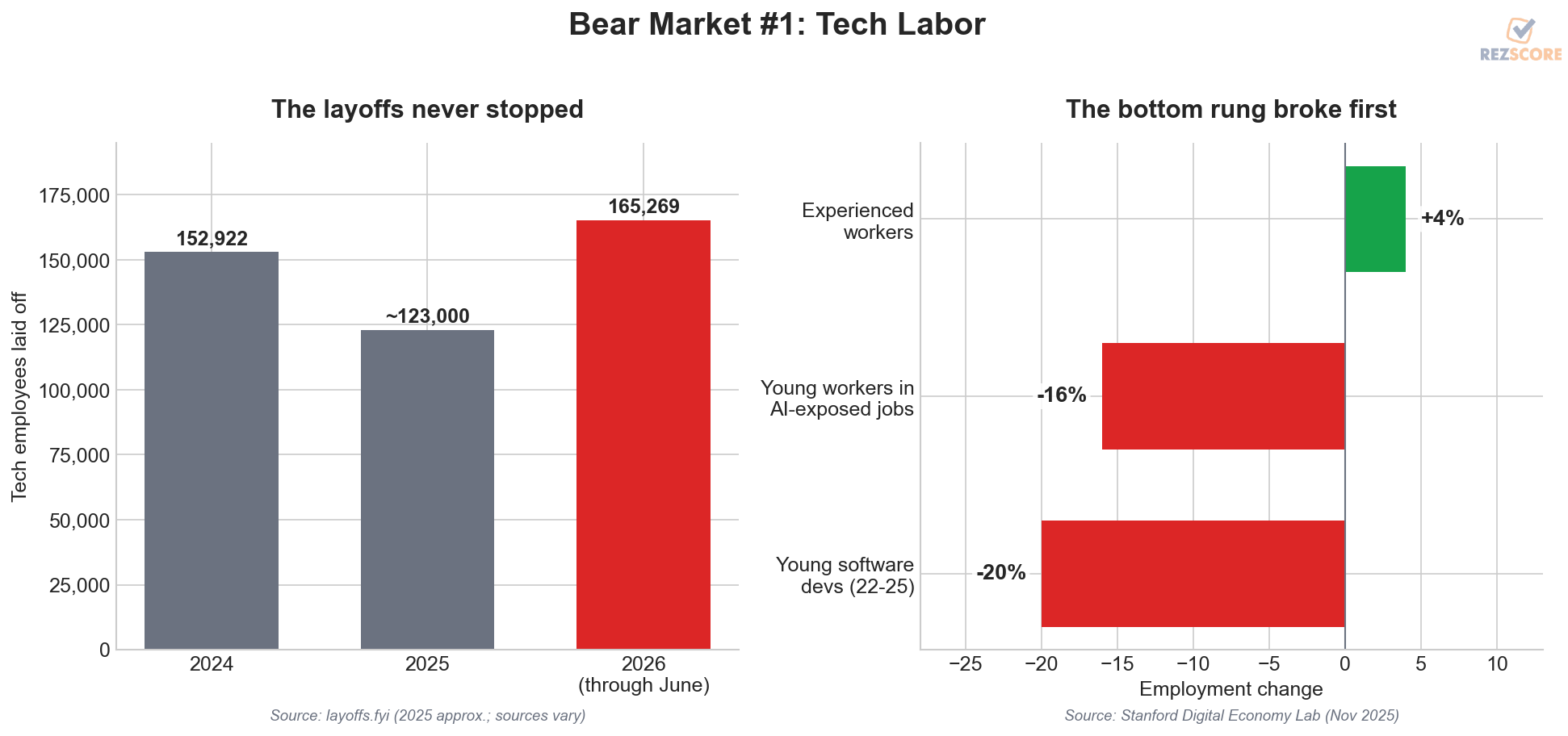
Per the widely-cited layoffs.fyi tracker, the tech industry shed 152,922 jobs across 551 companies in 2024, and another 165,269 across 1,064 companies in the partial year through early June 2026. (layoffs.fyi is a crowd-aggregated tracker, not an official statistic, and other trackers run somewhat lower - but the direction is not in dispute.)
The more important detail is who is getting hit. A November 2025 study from the Stanford Digital Economy Lab (Canaries in the Coal Mine?), using ADP payroll data covering millions of US workers, found that early-career workers aged 22-25 in the most AI-exposed occupations saw a roughly 16% relative employment decline versus their older, more experienced colleagues - whose employment stayed stable or grew. Young software developers specifically were down nearly 20% from their late-2022 peak.
A caution on that 20% figure, because it matters: the Stanford authors are careful to say it’s a descriptive number, not a clean measure of AI causation - interest rates and the 2022 R&D tax-law change are tangled up in it too. But the shape is clear. The bottom rung of the ladder is where the market broke.
You can even see it upstream, in the pipeline. After roughly a decade of steady growth, undergraduate computing enrollment just reversed: the Computing Research Association’s 2025 Taulbee data showed a 3.1% decline across matched programs - a nearly 10-point swing from the prior year’s +6.6% increase. Here’s the honest nuance, though, the same nuance those students gave me: new CS majors were still growing +12.7% as recently as the 2023-24 cycle, the fourth straight year of growth. The decline is brand new, showing up only in the latest data. And much of the graduate-level decline is really an international-student visa story, not domestic students abandoning the field. So: a decade of growth that just turned down - not a field that’s been dying for years.
The second bear market: crypto prices, and the vibes are bad
Now the part that’s less obvious unless you watch crypto closely: it’s having its own bear market, on a much faster clock.
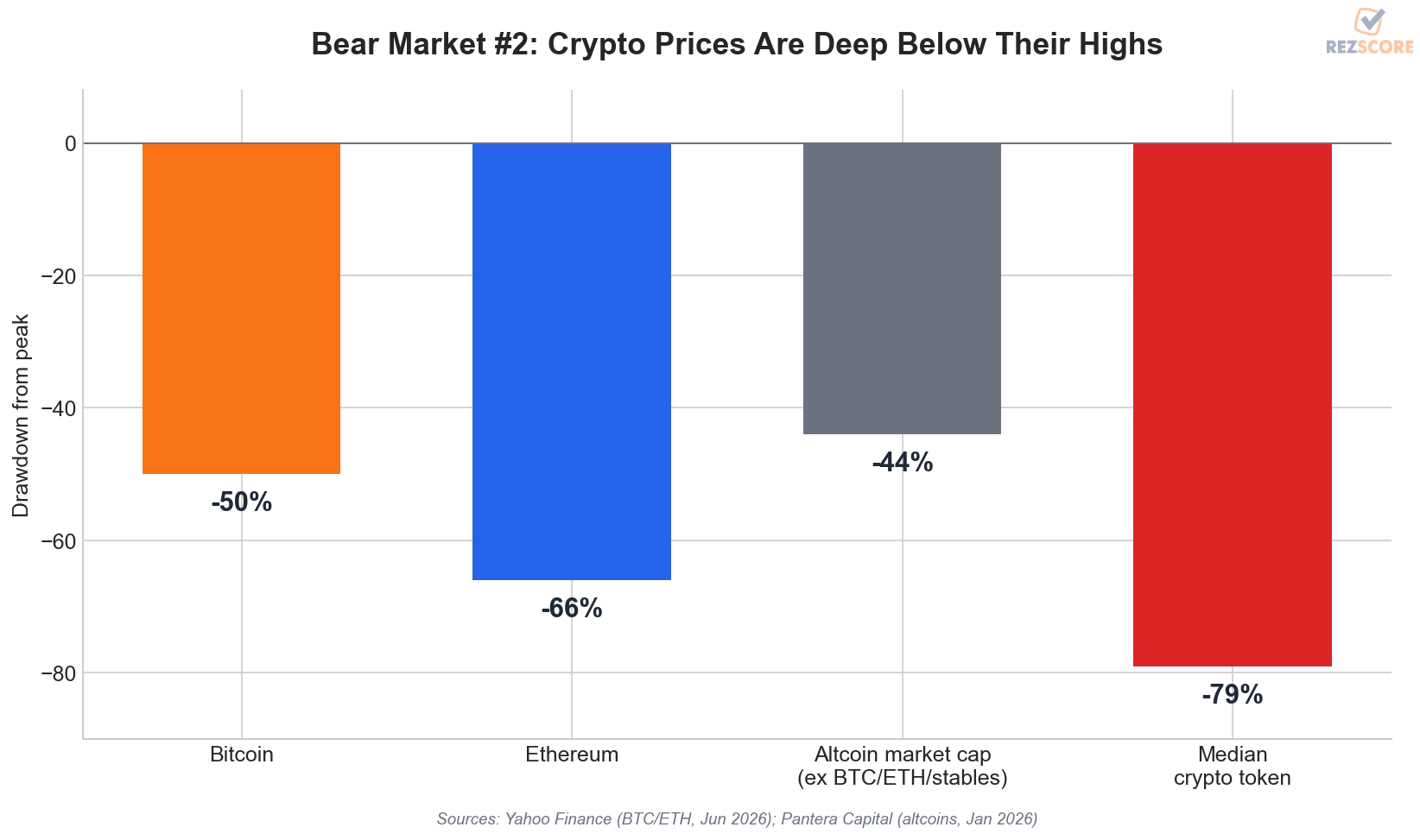
As of June 12, 2026, Bitcoin was trading around $63,553 - roughly 50% below its all-time high of about $126,000 set in October 2025. Ethereum was worse: around $1,672, roughly 66% below its August 2025 high of $4,954. And that was a morning the market was actually bouncing, on news that a Middle East war had wound down; a few days earlier the Crypto Fear & Greed Index had hit 12 - “Extreme Fear,” its lowest reading of the year, with a single day wiping out $1.8 billion in leveraged positions.
And the headline coins are the survivors. According to Pantera Capital’s January 2026 Blockchain Letter, the altcoin market has been in a sustained bear market since late 2024: by the end of 2025 the median crypto token was down about 79% from its late-2024 peak, and the total market cap excluding Bitcoin, Ethereum, and stablecoins had fallen about 44% from that peak. Pantera - itself a crypto investor, so read the framing accordingly - described sentiment as compressed to “levels historically associated with capitulation.”
In plain terms: prices are in the dumpster and the mood is worse. If you only looked at the price chart, you’d conclude the industry was over.
The twist: the money never actually left
Here’s where the synchronicity gets interesting. While prices crashed, the institutional side of crypto quietly hit record highs.
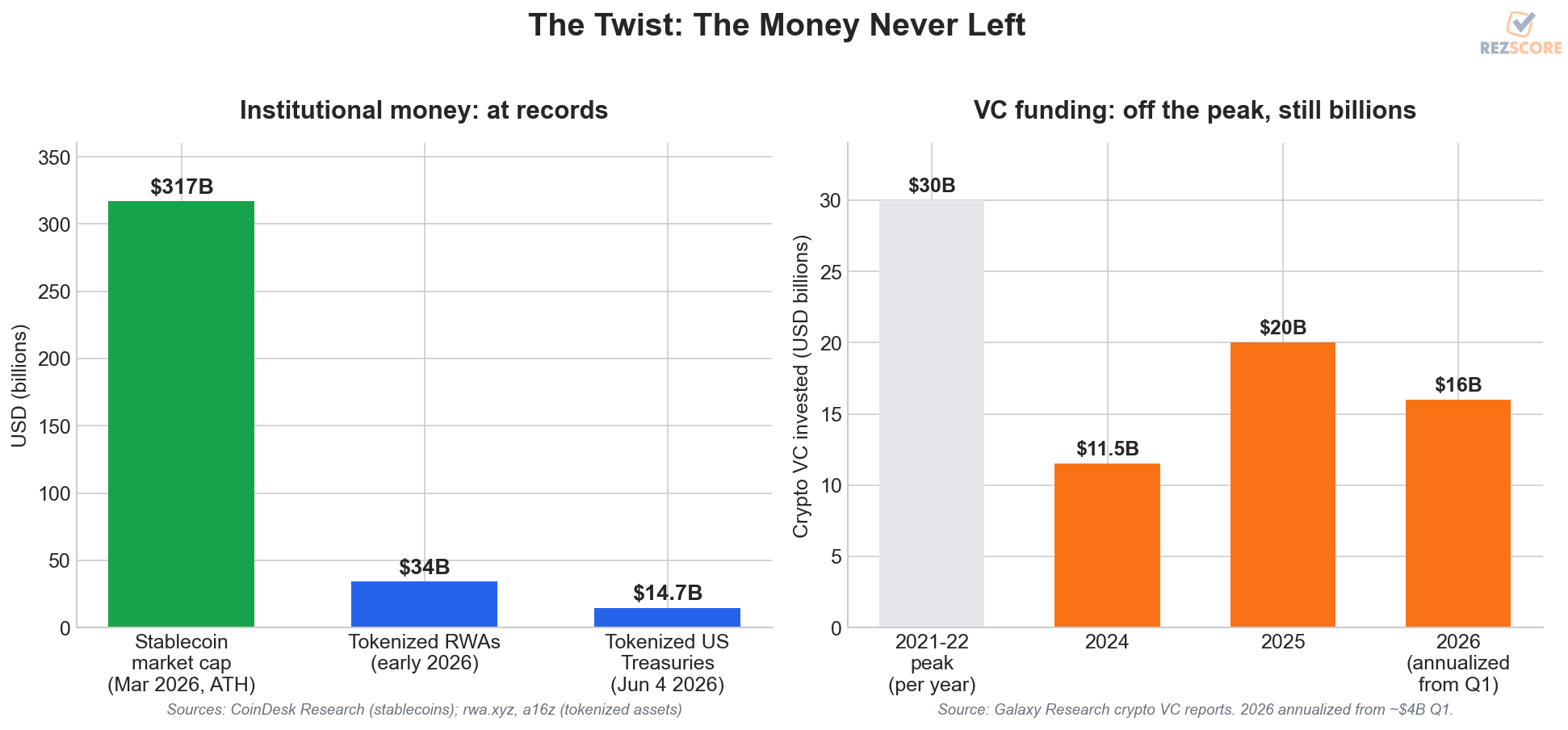
Stablecoins - dollar-pegged tokens, the boring plumbing of the industry - reached an all-time-high market cap of $317 billion in March 2026, per CoinDesk Research, a second consecutive monthly record. Tokenization of real-world assets, long dismissed as a slide-deck fantasy, became real: tokenized U.S. Treasuries stood at about $14.7 billion as of June 4, 2026 (rwa.xyz), and the broader tokenized-asset market crossed $30 billion, holding around $34 billion through early 2026. The names doing it are not degens: JPMorgan, Franklin Templeton, Fidelity, UBS, Apollo.
Venture money tells the same story. Crypto VC is well off its mania-era peak of roughly $30 billion a year in 2021-2022 (Galaxy Research). But “off the peak” is not “gone”: funding ran about $11.5 billion in 2024, recovered to nearly $20 billion in 2025, and Q1 2026 saw about $4 billion across 355 deals - a pace that annualizes near $16 billion. (Trackers differ on the exact totals depending on what they count; we use Galaxy’s figures throughout for consistency.)
That’s the contrast that is the story: the price chart says capitulation, and the money flow says record institutional adoption. Both are true at once. The speculative froth burned off; the durable demand - payments, settlement, tokenized assets - kept building. That’s a very different signal than “crypto is dead,” and it’s the one a careful job-seeker should pay attention to.
It also tracks with what the industry is actually talking about day to day. Of the most-discussed topics on the crypto-news platform Leviathan News over the past week (per its trending-topics data, as of June 4, 2026), the leaders weren’t meme-coins - they were Stablecoins, Markets, Institutional Adoption, Real-World Assets, Infrastructure, and Payments. The conversation has moved to building, even while the price chart bleeds.
So who’s hiring, and what does it pay?
This is the leg where I have to be careful, because the clean data is thinner. I’m not going to hand you a precise “number of open crypto jobs,” because the figures I found for that didn’t survive fact-checking, and the whole point of this exercise is to not make things up. What I can hand you is the running source we leaned on while writing this piece and should have cited from the start: Leviathan News’ Atlas hiring tracker, a live view of which crypto teams are actually hiring right now. If you want the ground truth on open roles, start there.
What is well-sourced is compensation by skill. As of mid-2026, aggregated job-listing data from web3.career puts average pay for specialized crypto-engineering skills like this:
| Skill | Avg Salary | Range |
|---|---|---|
| Cryptography / security | ~$178k | $80k-$300k |
| Solidity | ~$150k | $65k-$257k |
| Rust | ~$150k | $80k-$275k |
| Blockchain (general) | ~$150k | $78k-$262k |
| Smart contracts | ~$125k | $60k-$250k |
(These are scraped job-listing figures, not a rigorous comp survey, so treat them as directional.) The pattern, though, rhymes with something we wrote about earlier this year analyzing the broader AI job market: the premium goes to the specialized, deeper-stack skills. “I’ve used a blockchain” is table stakes. Smart-contract security and protocol-level engineering are where the money concentrates - and they’re skills a strong web2 engineer can credibly grow into.
“More code, fewer coders”
One more idea from that meetup, and it’s the one I keep turning over. A student argued: thanks to AI, the raw volume of code being written is exploding, while the number of humans interested in writing it is flat at best. More code, fewer coders. Net-net, more opportunity for the coders who remain.
The data supports the two halves of that - as facts, with the conclusion left as the argument it is.
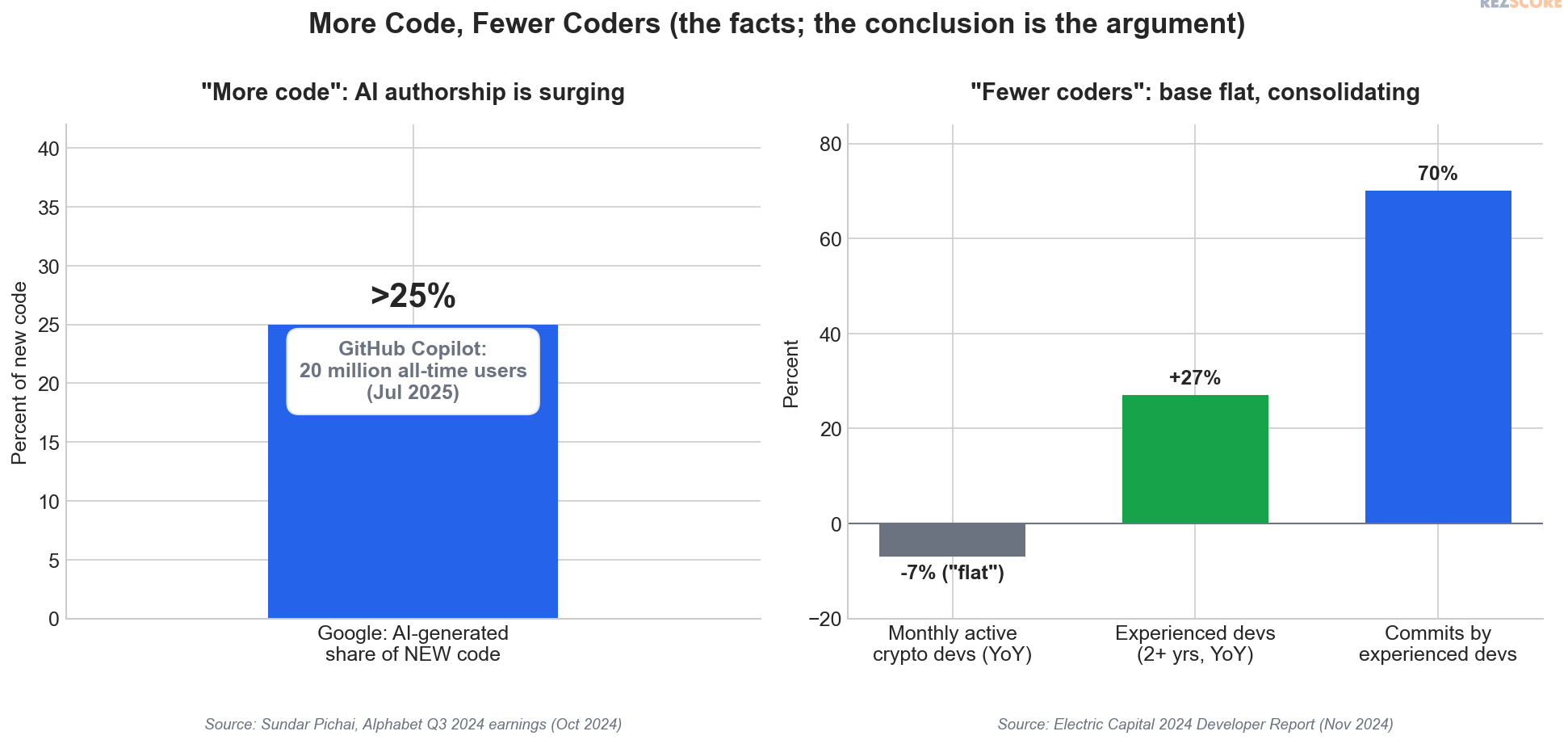
On the “more code” side: Google CEO Sundar Pichai said in October 2024 that more than 25% of new code at Google is now AI-generated (then reviewed and accepted by engineers). GitHub Copilot crossed 20 million all-time users by July 2025. AI is unambiguously producing a rising share of the world’s code.
On the “fewer coders” side: the Electric Capital 2024 Developer Report counted about 23,613 monthly active crypto developers - a statistically insignificant 7% year-over-year change. Roughly flat, not collapsing. And underneath that flat number, something telling: experienced developers (two-plus years in crypto) grew 27% year-over-year and now write about 70% of all the code. The base isn’t growing - it’s consolidating around people who know what they’re doing.
Put the halves together and you get the student’s thesis: the work is expanding, the experienced-human supply isn’t, and the people who establish themselves now are the ones who’ll write the 70%. We’re showing it as an argument, not a law - but it’s a reasonable one.
What this actually means for you
If you’re a developer who’s been laid off, or watching your team get thinner, here’s the read:
- The downturn is real, and it’s worst at the entry level. Pretending otherwise doesn’t help you.
- Crypto is not where the froth is anymore - it’s where durable, well-funded building is happening. Record stablecoin supply, real institutional tokenization, and still ~$16 billion a year of venture money chasing it.
- The opportunity is repositioning, not restarting. You don’t need to become a different engineer. A web2 backend or security background maps directly onto smart-contract development and protocol work - the highest-paid corners of the field. A stint at a crypto startup is plentiful right now, looks credible on a resume, and puts you near genuine innovation while the broader market is frozen.
The catch is that “repositioning” is a resume problem before it’s a job-search problem. A hiring manager at a crypto protocol skims your resume the same way any hiring manager does - in seconds - and if it reads as “generic web2 engineer,” you’re invisible, regardless of how transferable your skills actually are.
How RezScore fits
This is the part we can help with. RezScore grades your resume the way a hiring manager reads it, and our AI builder helps you reframe what you already have for the roles you’re targeting - surfacing the security work, the systems experience, the protocol-adjacent projects that a recruiter at a crypto company is actually scanning for. Not inventing experience you don’t have. Reframing the experience you do.
If the twin bear markets have you reconsidering where your skills fit, that’s exactly the moment to run your resume through a free resume grader and see how it reads to someone on the other side of the table.
RezScore has graded over 13 million resumes since 2014. Every statistic in this post comes from a named, dated public source - listed below. Where a claim couldn’t be verified, we dropped it rather than guess. Full methodology and citations →
Sources
- Crypto funding - Galaxy Research
- Developer counts - Electric Capital Developer Report
- Crypto prices & sentiment - Pantera Capital, CoinDesk, rwa.xyz, and the Crypto Fear & Greed Index
- Tokenization / institutional adoption - a16z crypto, CoinDesk Research
- Labor market - layoffs.fyi, the Stanford Digital Economy Lab, and the Computing Research Association
- Compensation by skill - web3.career
- AI-generated code - public statements by Google and Microsoft
- Industry sentiment & topic discovery - Leviathan News (trending-topics data)
- Live crypto hiring tracker - Leviathan News Atlas: Hiring (added in a post-publication update; we used it while researching and neglected to cite it in the first version)
See how your resume actually scores.
Grade my resume - freeTry the free resume grader to see your resume score in seconds.
← All posts