
Before you rewrite your resume, build an evidence inventory
Capture eight evidence fields about your work before drafting resume bullets. The result is honest source material you can reuse for different job targets.
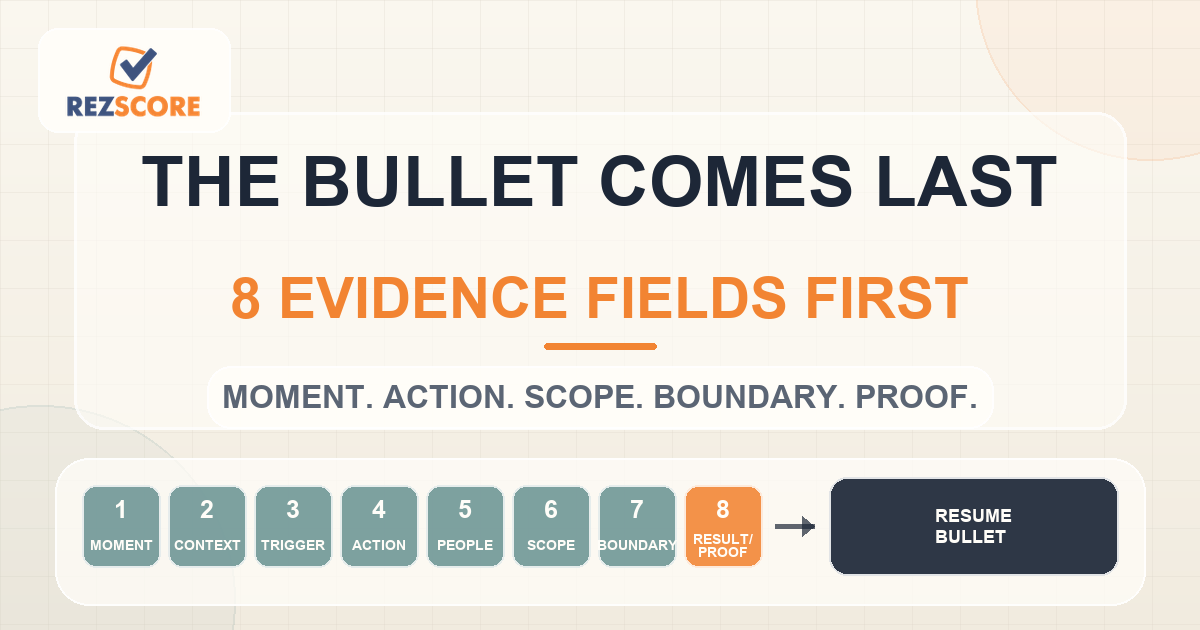
Do not start by rewriting the bullet.
Start with one work moment you remember clearly: a coverage gap, a vendor problem, a delayed handoff, a new employee’s first week, an inventory shortage, or a customer escalation. Record what happened while you can still separate your work from everyone else’s.
That record is your evidence inventory. It gives you honest source material for a resume, an interview, and more than one job target. The finished bullet comes later.
Think of it as a source record that sits before any resume template.
Why drafting first creates trouble
A blank resume line invites polished language before the facts are ready. You reach for a stronger verb, try to remember a number, and compress several people’s work into one sentence. The result may sound confident while leaving basic questions unanswered.
An evidence inventory slows that step down. Rough notes, visible placeholders, proof sources, and authority boundaries can stay in this private working document while the finished line remains concise and defensible.
Use the following eight fields for each work moment.
1. Work moment
Give the event a short label tied to a real period: “January coverage disruption,” “warehouse count correction,” or “new vendor onboarding.” A specific moment is easier to reconstruct than a broad duty such as “handled scheduling.”
2. Operating context
Name the department, location, process, customer type, system, or service involved. Context establishes where the work sat without making the bullet long.
3. Trigger or problem
Record what required action. A missed deadline, staffing gap, recurring error, policy change, complaint pattern, or supply delay gives the work a reason.
4. Your action
Write what you personally did. Chose, built, checked, coordinated, trained, proposed, escalated, and monitored each describe a different contribution. Pick the verb that survives a follow-up question.
5. People and partners
List the people involved and your relationship to them. They might be direct reports, peers, trainees, vendors, customers, or leaders who approved a recommendation. This field keeps coordination from quietly becoming a false people-management claim.
6. Scope
Capture any scale you can support: frequency, staff, shifts, locations, cases, orders, vendors, duration, or budget range. Exact numbers help when they exist. Named work and operating span still count when they do not.
If a number needs research, leave a visible placeholder and note where to check it. Our guide to quantifying a resume without inventing numbers explains how to use defensible estimates and nonnumeric scope.
7. Boundary and authority
Record what you decided, recommended, monitored, or carried out, along with who held final approval. This is the field most likely to disappear during a rushed rewrite.
If you proposed overtime and a manager approved it, keep both facts. If you trained employees without evaluating them, record training rather than direct reports. The ownership test for management-shaped work offers more examples.
8. Observable result and proof source
Write what changed, then name where you could verify it. A schedule, checklist, report, calendar, email, ticket, audit, or manager may confirm the story. Some useful work has no measured outcome. In that case, name the completed deliverable or operating condition you can support.
Avoid inventing an “impact” because the field looks empty. Mark the result unknown, look for a source, or draft the bullet without it.
Build records from ordinary operations work
Ordinary recurring work is enough. It can be a useful place to find clear evidence because you can describe the process and your authority accurately.
Look through the last year for moments involving:
- Staffing, shift coverage, or schedule changes
- Training, onboarding, or a revised guide
- Vendor delays, renewals, or service problems
- Inventory shortages, purchasing, or equipment allocation
- Customer or employee escalations
- Quality, safety, compliance, or audit preparation
- Handoffs across teams, departments, or locations
- A recurring problem you helped prevent or resolve
Choose one moment at a time. A record that mixes an entire year of unrelated work will be hard to verify and harder to turn into a clear bullet.
Worked example: a coverage disruption
This fictional record uses placeholders on purpose.
Work moment: [Month and year] coverage disruption
Operating context: [Department] at [location or locations], using [scheduling system]
Trigger or problem: [Number] absences created a coverage risk for [shift or service]
Your action: Reworked [period] coverage and contacted available [roles]
People and partners: Coordinated with [team or manager] and informed [stakeholder]
Scope: [Number] staff, [number] shifts, [number] locations
Boundary and authority: Proposed coverage changes; [manager role] approved [specific exception, if applicable]
Observable result and proof source: [Verified outcome, if known]; verify with [schedule, email, or manager]
A defensible bullet could read:
Reworked [period] coverage for [number] staff across [number] shifts after [number] absences, coordinating available [roles] and [record approval step, if applicable] to [state verified outcome].
Treat every bracket as unfinished work. Fill it, verify it, or remove it.
Use one record for more than one target
The same evidence can support different resume versions when the facts stay fixed.
For a first-line supervisor opening, the coverage record may lead with staff, shifts, and recurring schedule responsibility. For a project-oriented role, it may lead with the disruption, coordination, decision path, and completed service outcome. Neither version changes your title, authority, or result.
Keep one complete record as the source. Draft each version from that record, then compare it with the opening. This keeps tailored versions anchored to the same verified facts. Our guide to using AI without letting it make things up explains why one completely true master copy matters.
Handle unknown and sensitive facts carefully
Use four simple labels in the working record:
- Known: You can explain and support the fact now.
- Verify: You know where to check it.
- Estimate: You have a stated basis and would describe it honestly as an estimate.
- Unknown: Leave it out until you can support it.
Keep confidential customer names, employee details, sensitive internal figures, and protected information off the resume. A truthful range, category, or description of operating span may carry the point without exposing sensitive data.
Choose three records before you draft
Pick three work moments from the last year. Complete all eight fields for each one. Then draft a bullet from the strongest record and check every verb, number, boundary, and result against your notes.
Grade your resume free when the revised bullets are ready. The goal is simple: let a reader see the evidence you can actually explain.
See how your resume actually scores.
Grade my resume - freeTry the free resume grader to see your resume score in seconds.
← All posts