
You may already be doing management work without the title
Coordinators, supervisors, administrators, and senior specialists can carry real management-shaped responsibility. Use specific evidence to show the work without inflating your title or authority.
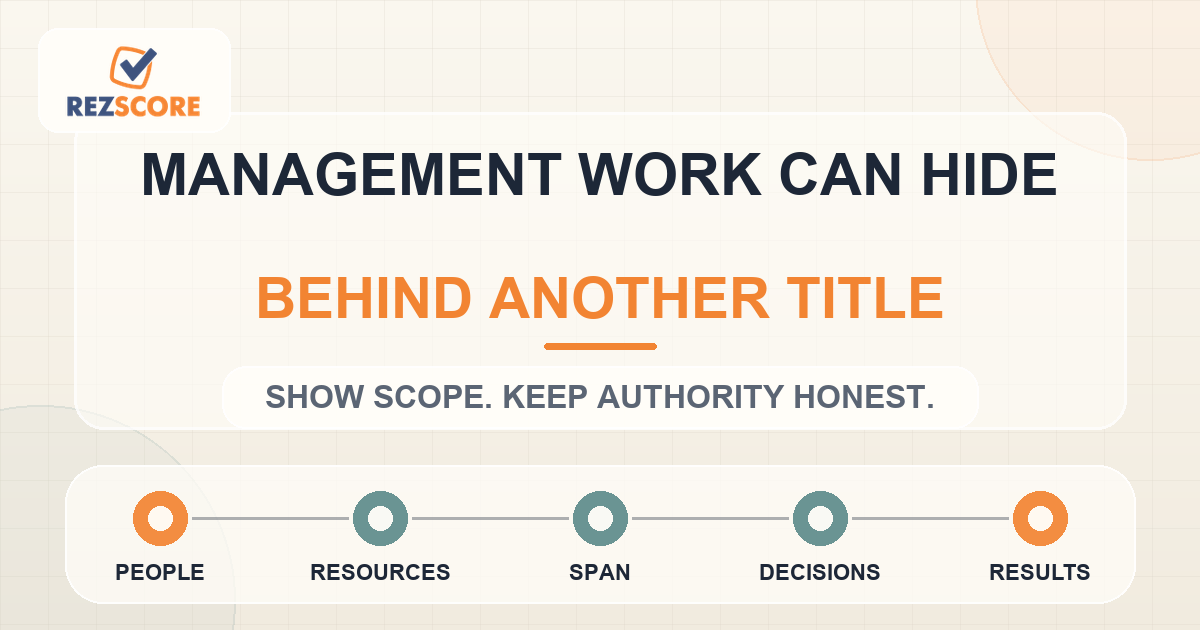
Before you call yourself a manager, look at the work people already trusted you to own.
You may have built coverage plans, trained new staff, handled escalations, coordinated vendors, or kept a process moving across teams and locations. That work can be useful evidence for a management search. It still needs an honest label.
Coordination, project leadership, first-line supervision, and general operations management carry different kinds of authority. Your resume should show the responsibility without upgrading the title or authority.
The title is only one clue
Job titles are not a clean taxonomy. O*NET lists “Office Coordinator” and “Office Manager” as sample titles for the same first-line supervisor occupation. It also lists “Production Manager” under first-line production supervision, while its separate general and operations manager category usually manages through subordinate supervisors and oversees broader organizational operations.
The verbs overlap too. General and operations managers schedule staff, direct budgets, work across departments, handle personnel functions, set procedures, and monitor suppliers. First-line office supervisors prepare schedules, train employees, resolve escalations, coordinate work units, recommend staffing changes, and help plan budgets. Project management specialists coordinate schedules, staffing, budgets, vendors, milestones, and stakeholders on a project basis.
Shared tasks explain why a job title can hide relevant experience, while the differences in authority still matter.
Use the ownership test
List what you were personally trusted to own. Then record the boundary around that ownership.
People
Record whom you trained, scheduled, supported, or coordinated, and whether you evaluated or hired them. Do not claim direct reports when you did not manage performance or employment decisions.
Resources
Record the budget, inventory, vendors, equipment, or coverage you monitored or controlled. Do not claim budget ownership when someone else approved spending.
Operating span
Record the locations, shifts, cases, customers, systems, or recurring processes involved. Do not imply organization-wide scope when the work was local.
Decisions
Record the priorities you set, escalations you handled, tradeoffs you recommended, and policies you implemented. Do not imply final authority when you made recommendations.
Results
Record a measured outcome, durable process change, or named piece of work. Do not add a percentage, promotion, or title you cannot defend.
If you trained eight new employees but did not evaluate them, say that you trained them. If you tracked a departmental budget but a director authorized every purchase, say that you monitored spending or prepared budget reports. If you led a launch across three teams but everyone still reported to their own manager, say that you coordinated the project.
Precise verbs make the scope more credible.
Turn activity into management evidence
For each activity, add the scale, limits, decisions, or result that a reader can judge.
Activity: Managed schedules
Evidence: Built weekly coverage for [number] staff across [number] shifts or locations, within staffing levels set by [role].
Activity: Trained new employees
Evidence: Trained [number] new [roles] on [process or system] and updated the [guide or checklist] used by [team].
Activity: Handled customer issues
Evidence: Handled escalations involving [issue type] for [customer group], coordinating resolution with [team or vendor].
Activity: Tracked inventory and spending
Evidence: Monitored [inventory, budget, or category] for [location or team], flagged [shortages or variances], and recommended [action] to [decision-maker].
Activity: Led a project
Evidence: Coordinated [project] across [teams or locations], tracked [milestones or dependencies], and delivered [verifiable outcome] with [manager or owner] approval.
The placeholders are deliberate. Replace them with facts you know, research the answer, or rewrite the line without the missing number. Our guide to quantifying a resume without inventing numbers shows how to use scope, named work, and defensible estimates when no dashboard exists.
Know which kind of leadership you have
Management-shaped work appears at several levels. Keeping those levels separate helps you choose plausible targets.
You supported the work
You gathered information, kept records, scheduled meetings, or followed an established process. This experience can show reliability and operating knowledge. It does not show ownership by itself.
You coordinated the work
You aligned schedules, people, vendors, milestones, or handoffs. You may have assigned project duties or acted as the contact point. This is coordination or project leadership unless you also held formal authority over people or ongoing operations.
You supervised people directly
You assigned recurring work, prepared staff schedules, trained employees, evaluated performance, or resolved team problems. That overlaps with first-line supervision. O*NET treats first-line supervisors as distinct from general and operations managers.
You managed an operating unit
You owned results for a department, location, territory, or business unit and controlled some combination of staffing, budget, policy, resources, and performance. Broader general and operations management often extends across multiple departments or locations and through subordinate supervisors.
Name coordination and first-line supervision accurately. Both are worth describing.
Compare the evidence with the target
A better resume cannot close every qualifications gap. It can make the experience you already have easier to judge.
Take the ownership inventory and compare it with three to five openings that genuinely interest you. Mark each requirement as supported, adjacent, or missing. If most of your evidence is project-based, a project management specialist role may be nearer than a general manager role. If you have recurring responsibility for staffing, quality, schedules, and team performance, a first-line supervisor role may fit. If you already own a department or location and make decisions across resources, people, and results, broader operations roles may be plausible.
Treat this as a targeting exercise. Keep your official title accurate and let the bullets carry the case.
RezScore’s Presentation and Qualifications scores separate these two problems. Presentation asks whether the document shows specific evidence. Qualifications asks how your background reads against a target. Clearer wording can improve Presentation. For a fixed target, relevant experience is what closes a Qualifications gap; correcting the target can also change the read.
Make the next honest edit
Choose one bullet that hides responsibility behind a vague verb such as “helped,” “supported,” or “handled.” Add the people, resources, operating span, decision, or result you actually owned. Then read it as an interviewer would. Every number, verb, and boundary should survive a follow-up question.
Do not let an AI upgrade your title or fill a blank with a flattering metric. We have a separate guide to using AI on a resume without letting it make things up.
Grade your resume free to see whether your strongest work reads as specific evidence or as a list of duties.
Sources
See how your resume actually scores.
Grade my resume - freeTry the free resume grader to see your resume score in seconds.
← All posts