
You got your resume grade. Now what?
The most common question after a resume grade is not about the grade. It is: what do I actually do next? Here is the exact order of operations, from evidence bullets to job targeting to the re-grade.
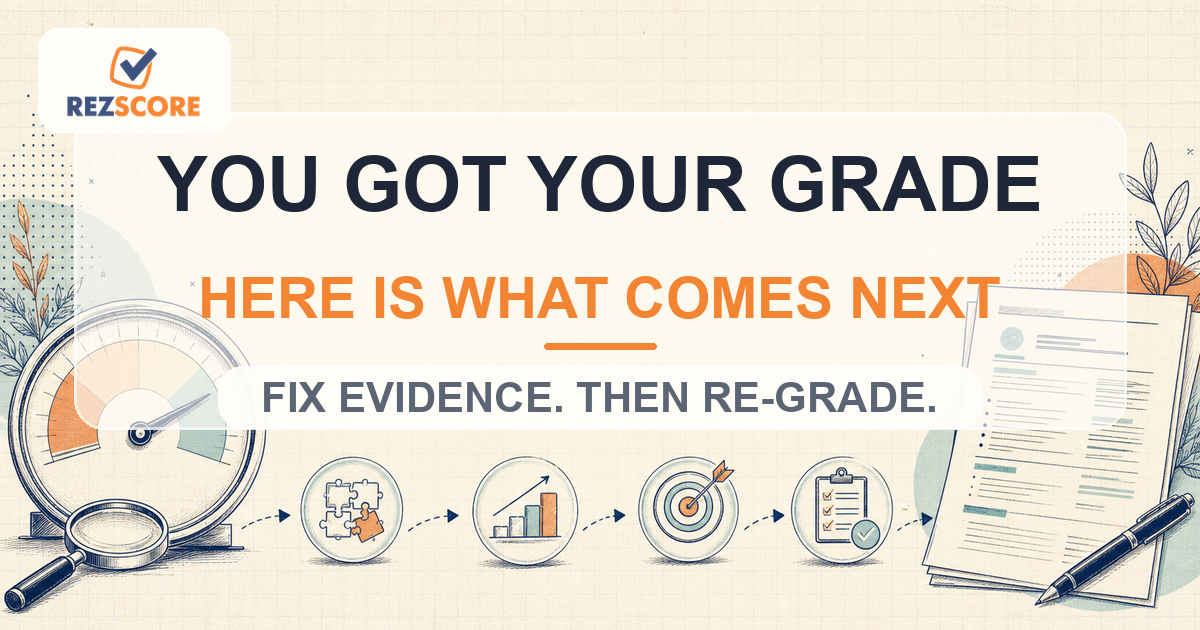
The grade is the diagnosis. This is the treatment plan.
If you need a starting point, use a free resume grader before working through the steps below.
The question everyone actually asks
We read a lot of conversations between job seekers and Jen, our AI career advisor. The most common question after a grade lands is not “why did I get a B minus.” By a wide margin, it is some version of: okay, what do I do next?
Fair. A grade without a plan is just a mood. So here is the plan, in the order that actually moves the needle, based on what we see across more than 70,000 graded resumes.
First: read the breakdown, not the letter
Your grade comes with a category breakdown across five areas: parseability, structure, evidence and impact, positioning, and credibility. The letter tells you how far you have to go. The breakdown tells you where. Evidence and impact carries the most weight of the five, which is deliberate: specific accomplishments are the single strongest separator between resumes that get read and resumes that get skimmed past.
Find your weakest category. That is your starting point, and it is usually evidence.
Step 1: Rewrite your top bullets as proof
Take the three bullets describing your most impressive work. For each one, ask: does this say what I was responsible for, or does it show what I actually did? “Managed the front of house” is a job description. “Trained 14 new servers over three years and wrote the onboarding checklist the restaurant still uses” is proof, and only one of those two gets remembered.
You do not need a spreadsheet of metrics to do this. If you have real numbers, use them. If you do not, specificity has more than one shape, and we wrote a full guide on quantifying your resume without inventing numbers. What you must never do is let an AI fill the gap with numbers that never happened. That bullet becomes a landmine in your interview.
This step is where most grades move the most. Do it before anything else.
Step 2: One structure pass, and only one
Now make the document scannable: strongest material on the top half of page one, consistent formatting, sections in the order a recruiter expects, nothing that forces a reader to hunt. Structure problems are real, but they are cheaper to fix than evidence problems and worth less, so give this a focused pass and stop. Endless font-and-margins tinkering is the most popular way to feel productive without getting better.
Step 3: Target one real job
Generic resumes are the default in 2026, which is exactly why they are invisible. Take one posting you actually want, and tailor your resume to it: mirror the language of the role, lead with the experience that matches, cut what does not serve this specific application.
RezScore does this for you: name the role or paste the job posting, and it rebuilds your resume to fit while keeping your real experience intact. Your first targeted resume is free. However you do it, per-job targeting is the biggest single lever you control after your evidence bullets.
Step 4: Re-grade and check the delta
Upload the revised version and grade it again. You are looking for two things: did the letter move, and did the weak category move? The before-and-after is the point. It confirms the work landed, and it tells you what to fix in the next pass. If the score barely moved after real edits, look at whether your changes added evidence or just rearranged words. Rearranged words do not score, and honestly, they do not read any better to a recruiter either.
Step 5: Keep one master copy that is completely true
Tailor a fresh copy from your master for each serious application. Never tailor from a tailored copy: that is how exaggerations fossilize and how you end up in an interview defending a line you do not remember writing. If any AI tool touched your resume along the way, run our five-minute audit for AI-written resumes before you send anything.
What not to do
Do not chase a perfect score forever. Across everything we have graded, an A is genuinely uncommon, and the honest goal is not a flawless number. It is a resume a recruiter stops on. The score is a tool, not an oracle: when it has done its job of pointing you at the weak spots, the remaining work is applying to jobs, not polishing the same line an eleventh time.
And do not spray one generic resume at a hundred postings and conclude resumes do not matter. That experiment has a known result. We wrote about why applications go unanswered and which parts of the silence you can actually control.
Start here
If you have not been graded yet, grade your resume free. It takes seconds, the breakdown is the to-do list, and this playbook is what to do with it.
See how your resume actually scores.
Grade my resume - freeTry the free resume grader to see your resume score in seconds.
← All posts