
Why your job applications get no response (and what a resume can actually fix)
Dozens of applications, months of silence. An honest accounting of what is actually happening to your applications in 2026, which parts a resume can fix, and which parts it cannot.
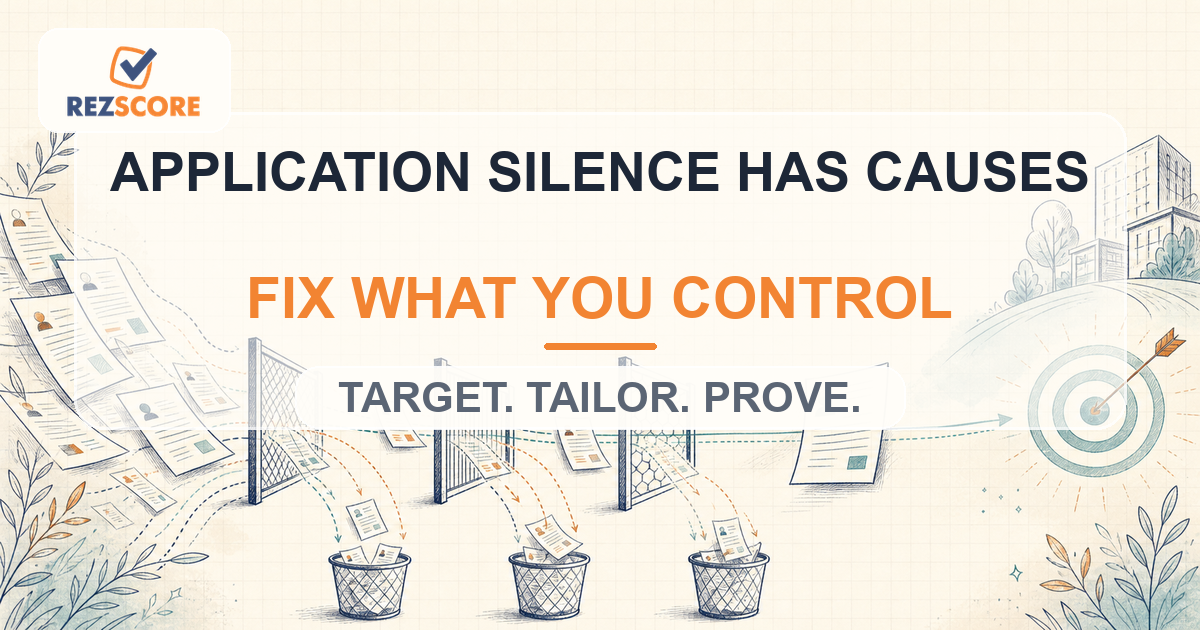
The silence is not in your head. Here is what is actually causing it, and which parts you can do something about.
The question under the question
We hear it from job seekers constantly, and rarely calmly: months of applications, dozens or hundreds of them, and nothing back. Not rejections. Nothing. The question underneath is always the same: is it me, is it my resume, or is it the market?
The honest answer is: it is partly each, and it matters enormously which part is which, because you can only fix some of them. Most career content will not tell you that, because “it is all fixable, buy our tool” is a better pitch. We would rather be accurate.
What is actually happening to your applications in 2026
Three published facts explain most of the silence.
First, software reads your resume before any human does. Somewhere between 83% and 99% of companies now use AI to screen applications. If your resume does not survive machine reading, the silence starts there, and no amount of quality past that point matters.
Second, you are competing with documents that all look the same. 65% of job seekers already use AI on their applications, and we watch the result arrive in our grader every day: thousands of near-identical resumes, same phrases, same structure, same emptiness. Polished and invisible is now the default resume. Meanwhile, hiring managers admit they penalize resumes that read obviously machine-written, even as their own companies screen with AI. The double standard is real, and it is the game as it exists.
Third, the funnel math is brutal, especially where everyone is applying. By one published estimate, 0.4% of resumes turn into the job. And if you are applying remote-only, know that explicitly remote-only postings are outnumbered by on-site roles about 66 to 1, which means you are aiming at the thinnest, most crowded slice of the market.
What a resume can actually fix
Given all that, a resume controls three things, and they are not small.
Surviving the machine. Clean parseability, standard structure, and language that matches the role determine whether a human ever sees you. This is table stakes, and it is fully in your control.
Being distinguishable. When screeners and recruiters see a wall of identical AI-written documents, specific evidence is what breaks the pattern: real projects, real scope, outcomes you can defend. This is the single biggest quality lever, and if your bullets currently describe responsibilities instead of proof, start with our guide on quantifying your resume without inventing numbers.
Matching the actual job. A resume tailored to the posting in front of you beats your general-purpose resume at every screening layer, human and machine. Tailoring per serious application is the strategy change with the highest return, and it is the one most people skip because it is tedious. It is also precisely what tools should automate: RezScore rebuilds your resume against a pasted job posting while keeping your real experience intact, and your first targeted resume is free.
What a resume cannot fix
Here is the part we will not pretend about.
A resume cannot fix demand in your field or your city. It cannot fix timing, a hiring freeze, or a role that was filled internally before it was posted. It cannot fix a seniority mismatch, and it cannot fix a strategy of spraying one generic document at a hundred postings, because that experiment has a known result and you have already run it.
And nobody, including us, can promise you a response rate. Anyone who does is selling something. What a stronger, targeted resume does is stop you from losing at the layers you control, so that the market factors are the only thing deciding, instead of a parsing failure or a generic bullet deciding first.
The plan that respects both halves
Fewer, better applications: pick postings you genuinely match, tailor for each one, and lead with evidence a human can remember. Grade your resume free to find your weak category, fix it with the post-grade playbook, re-grade to confirm the change landed, and then spend your energy where the resume cannot: your network, your targeting, and roles where the math is not 66 to 1 against you.
The silence has causes. Some of them are yours to remove. Remove those, and let the rest be the market’s problem instead of your resume’s.
See how your resume actually scores.
Grade my resume - freeTry the free resume grader to see your resume score in seconds.
← All posts