
The September surge is real. Your resume's problem is probably not the ATS.
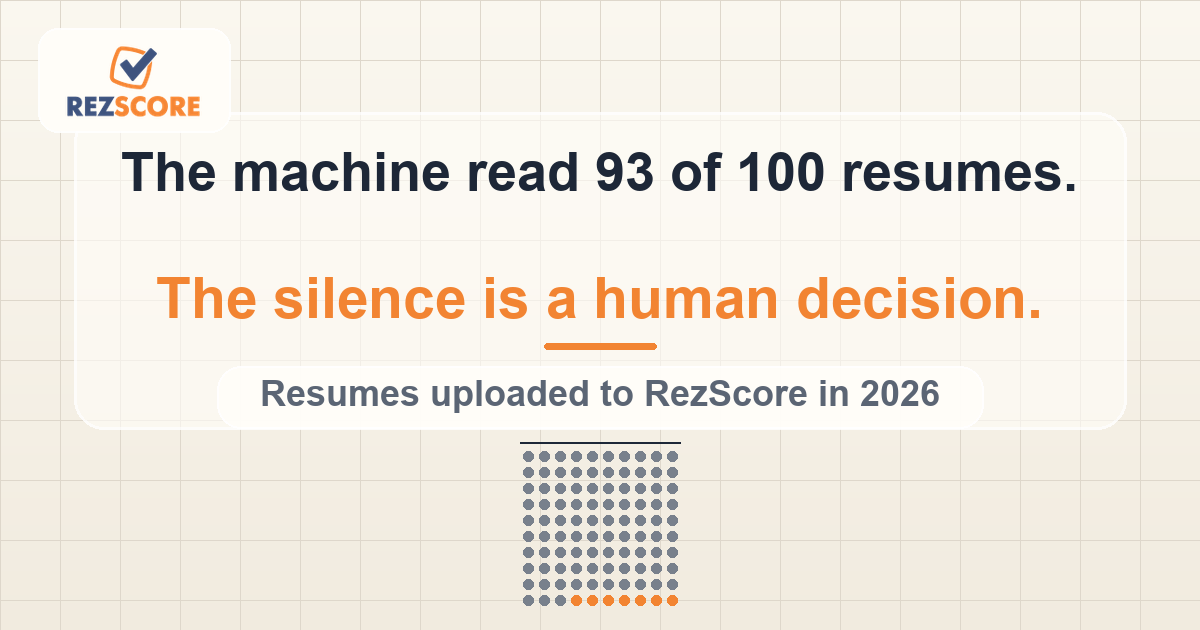
Job postings climb in September while applications fall, and the machine read 93 of every 100 resumes uploaded to RezScore this year. What the data says to fix before you apply this month.
The fall hiring window opened on schedule. Employers added 162,000 jobs in August against an LSEG forecast of 56,000, and unemployment held at 4.1 percent. LinkedIn’s postings data show the seasonal shape they show most years: postings dip 3 percent below March levels in August, then climb to 14 percent above March in September and 11 percent above in October. Applications run the other way. They peak between January and May and decline through the rest of the year. September is the month when the ratio of open roles to fresh applicants is at its best for the person applying.
That is the September surge, and it is real. It is also smaller than the phrase suggests. LinkedIn’s hiring rate rose 2 percent from July to August and remains more than 20 percent below its pre-pandemic level. The window is open, not wide.
The August gains were also lopsided. Women’s payroll employment rose by 158,000 of the 162,000 total, about 98 percent, and women now outnumber men on U.S. payrolls by 423,000, the widest margin in that series since 1990 by CNBC’s count from the same BLS table. The women’s gains came in leisure and hospitality, government, and private education and health. Professional and business services showed little change. Read those two facts together and the surge looks like this: the postings are up, the hiring so far has landed in a few sectors, and the professional roles most resumes are written for are still in the deciding stage. That is the case for applying early in the window rather than after the report that says the hiring already happened.
Here is the number from our side of the data that worries us more than any of those. We pulled ~3,600 resumes from users who uploaded a resume to RezScore from March 1 to August 15 and left an email address. As of this week, 5.3 percent of them have uploaded a revised version. The rest will walk into the best month of the year with the resume they had in spring, graded once and never touched.
If that is you, this is the short honest version of what to fix first. It starts by taking one fear off the table.
The robot read your resume
Every free resume checker on the internet, including ours, benefits from the story that applicant tracking systems throw away three quarters of resumes before a person sees them. The 75 percent figure has no study behind it. It traces to a 2012 sales pitch by a resume optimization company called Preptel, which went out of business the next year without publishing a methodology. Jobscan, which sells ATS optimization, now says that “an ATS rarely rejects a candidate automatically” and describes the software as a search engine recruiters use to filter and rank.
We can add measurement to that. Every resume uploaded to RezScore goes through the same kind of text extraction an applicant tracking system performs before anything is scored. Here is what happened to resumes uploaded so far in 2026.
| Outcome | Share of 2026 uploads |
|---|---|
| Parsed cleanly | 81.4% |
| Readable, but not in English | 11.2% |
| Partial extraction | 3.8% |
| Extraction failed | 3.6% |
About seven in a hundred had a real machine-readability problem. The machine read the other 93. Of the resumes that parsed, 97.2 percent scored 80 or higher out of 100 on our parseability category, which checks file structure, section detection, and whether the text came out as text. Across the whole modern corpus, the clean-parse rate is 96.9 percent, and 99.7 percent of those score 80 or higher.
If your resume is a PDF or Word file with normal section headings and no text trapped inside images, the software read it. Parseability is worth ten percent of a RezScore grade for exactly this reason: it barely separates anyone.
So when an application goes quiet, the odds are heavily against “the robot never saw it.” Something else happened.
What happened instead: 244 other people
Greenhouse’s 2026 benchmark report counts 116 applications per job in 2022 and 244 in 2025, which it labels a 111 percent rise. Ashby, looking at more than 100 million applications across 200,000 jobs, found that applications per hire have tripled since 2021 to more than 300 on average, and that a candidate today is roughly 50 percent less likely to receive an interview than five years ago.
A recruiter facing 244 resumes for one opening is not running a parsing test. They are running a triage, and the triage question is whether this one shows them something the last forty did not.
That is where the data says most resumes lose. On a fresh random sample of 5,000 resumes from our modern corpus, 42 percent contain at least one dollar figure or percent figure anywhere in the text. Fifty-eight percent contain neither. Grade by grade, the gap is the steepest thing we measure:
| Grade | Has a % or $ figure |
|---|---|
| A | 62.7% |
| B | 46.2% |
| C | 32.3% |
| D | 22.2% |
| F | 13.5% |
A number is not the only kind of proof, and we have written about how to quantify a resume when you do not have numbers. But a resume with no measurable result anywhere reads, at triage speed, like every other resume with no measurable result. In a stack of 244, that is the rejection.
The newer way to be invisible
There is a second way to disappear in that stack. Novoresume’s May 2026 survey of 2,000 U.S. adults found that 42.6 percent used AI tools the last time they updated their resume, and 27.1 percent have submitted a fully AI-generated resume without making a single edit. Resume Genius asked 1,000 hiring managers, and 80 percent say they can often tell when a resume has been written by AI.
We see the same thing from the inside. We watch near-identical AI resumes come through the grader: the same opening line, the same verbs, the same bullet shapes. They parse perfectly. They score in the middle. And they are indistinguishable from each other, which at triage speed is the same as being unreadable.
Using AI is not the problem. Submitting what it produced without putting your own evidence into it is. Why AI resume builders make things up covers the mechanism, and the fix is the same evidence pass described below.
What 2026 resumes look like
A few habits from this year’s uploads, for calibration:
- The median resume is 529 words. Our structure category treats 450 to 800 as the target range, so most resumes are the right length. Length is not the fix.
- 41.6 percent include a LinkedIn URL.
- 5.4 percent still open with an objective statement. That habit is nearly gone. An objective tells the reader what you want. A professional headline tells them what you are, and it sits where the reader starts.
What to do this week, in order
- Re-grade before you edit. If your grade is from spring, the rubric changed at the end of July, and the document may not be what you remember. Upload the current file to your report card. New upload, same report, free.
- Do one evidence pass, not a rewrite. Take the three roles that matter most for the job you want and find one measurable result for each: a number, a named client, a scope you owned, an outcome you shipped. Build the evidence inventory first, then cut the bullets that only restate the job title.
- Point it at one posting. Generic loses in a stack of 244. Your report card can target the resume to a specific job; name the role or paste the posting and check what changes.
- Fix the top line. If there is an objective, replace it with a headline. If there is a summary, make sure it says what you do and for whom, not what you hope to find.
- Then apply into the gap. Postings are 14 percent above March levels this month and applications are past their spring peak. The economists in Indeed Hiring Lab’s July survey, taken when unemployment was 4.2 percent, expect it to drift to roughly 4.4 percent by year end, so the window is not guaranteed to stay open into winter.
What a resume cannot do is change the 244. We wrote the honest version of why applications go unanswered and which parts a resume can fix. It can make you the one a tired reader stops on.
Where we stand
RezScore sells a resume builder and human rewrites, and the grader is the front door to both. You do not need either for the evidence pass above. The grade is free, the re-grade is free, and if you get to the end of the list and want help deciding whether to pay anyone at all, the decision guide says where we would tell you to keep your money.
Start with your report card
Open your report card, or grade your resume free. Read the grade, do the evidence pass, upload the revision, and compare. Then apply this month, not in January with everyone else.
Related reading
- What is a good resume score, for the full grade distribution behind the table above.
- What separates an A resume from an F, the data study this post draws on.
- The 2026 job market: what the data actually shows, for the screening changes behind the volume.
- Software engineering job market 2026, if you are a technical candidate.
- Free resume graders compared, for where each free tool stops.
- Presentation vs qualifications: how to read your two scores, if your grade and your experience disagree.
Methodology and sources
RezScore numbers, read from our production database on September 6, 2026, excluding test accounts and duplicate uploads. The 2026 parse table covers a sample of roughly 5,000 resumes uploaded since January 1, 2026 that have a scoring snapshot, using each resume’s latest snapshot. The modern corpus figure covers more than 40,000 resumes uploaded since November 2020 on the same basis. Parseability is scored 0 to 100 among resumes that parsed. The quantification figure comes from a random sample of 5,000 parsed resumes and counts any dollar or percent figure in the extracted text; the grade-by-grade table is reproduced from our earlier study, and the fresh sample landed within about two points of every row. Median length, LinkedIn, and objective figures are from the same 2026 snapshots. The returning-user figure is a sample of roughly 3,600 people who uploaded a resume with an email address between March 1 and August 15, 2026, and the share who have uploaded any later resume since. All figures are aggregates. No individual resume is shown or attributable.
External sources, in the order they appear:
- U.S. Bureau of Labor Statistics, The Employment Situation, August 2026, September 4, 2026. Payrolls up 162,000; unemployment 4.1 percent; professional and business services listed among industries with little change.
- U.S. Bureau of Labor Statistics, Table B-5, employment of women on nonfarm payrolls and Table B-1, employees on nonfarm payrolls, August 2026 release. Women employees rose from 79,591,000 to 79,749,000; total nonfarm from 158,913,000 to 159,075,000. The 423,000 gap is women employees minus the remainder.
- Fortune, Women accounted for 98% of U.S. job gains in August, Eva Roytburg, September 4, 2026, and CNBC, Women accounted for almost all of August payroll gains, September 4, 2026, for the framing and the record-margin calculation.
- Fox Business, August jobs report, September 4, 2026, for the LSEG estimate of 56,000.
- Fortune, What is the “September Surge”?, Tatiana Sataua, September 5, 2026. The postings, applications, and hiring-rate figures are LinkedIn’s, per Kory Kantenga, LinkedIn’s head of economics for the Americas.
- Greenhouse, The Hire Standard, March 2026. Applications per job: 116 in 2022, 244 in 2025.
- Ashby, 2026 Talent Trends Report press release, May 7, 2026.
- Novoresume, The Resume Report 2026, June 15, 2026. Pollfish survey of 2,000 U.S. adults aged 18 to 64, fielded May 2026.
- Resume Genius, Resume statistics, updated March 5, 2026, drawing on its own survey of 1,000 U.S. hiring managers. Vendor research; quoted as such.
- Indeed Hiring Lab, Q2 2026 labor market outlook survey, August 5, 2026. 120 economists, fielded July 2026.
- The Interview Guys, The ATS resume rejection myth, updated June 25, 2026, for the origin of the 75 percent figure.
- Jobscan, 8 things you need to know about applicant tracking systems, updated April 10, 2026.
See how your resume actually scores.
Grade my resume - freeTry the free resume grader to see your resume score in seconds.
← All posts