
Should you pay for a resume rewrite in 2026? A decision guide to DIY, AI, and human help
What DIY, AI tools, and human resume writers cost in 2026, what the evidence supports for each, and five questions that settle the decision for your situation.
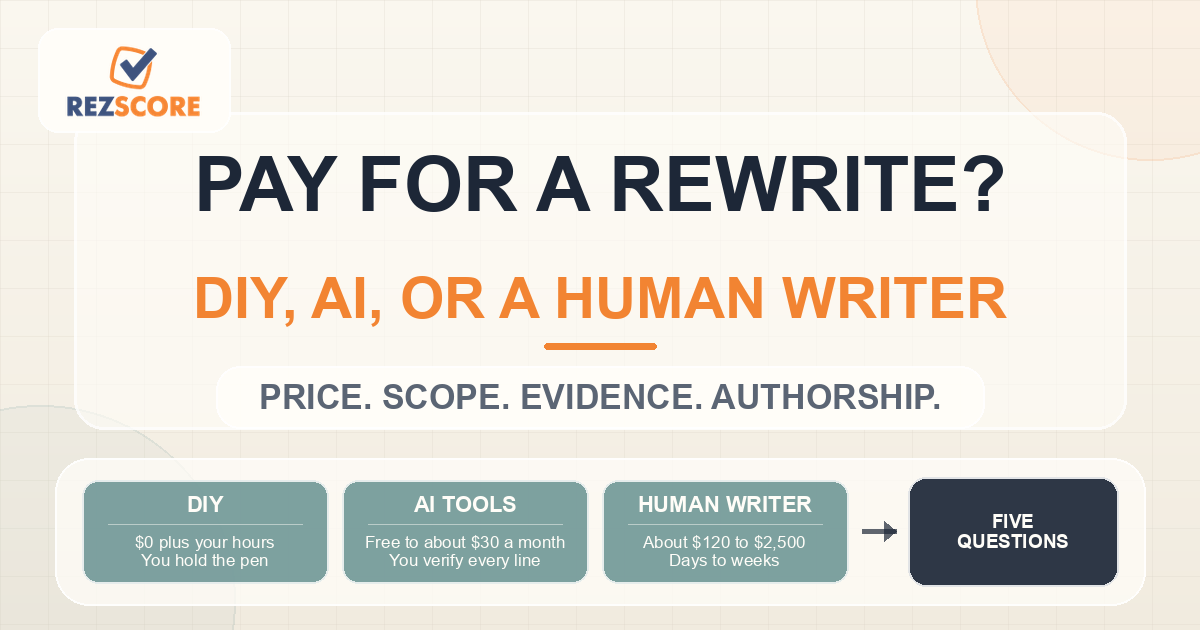
You have a graded resume, a job you want, and a decision to make: fix it yourself, hand it to an AI, or pay a person.
Three routes, and each one comes with a loud sales pitch. This is the quiet version: what each route costs in 2026, what the evidence actually supports, and five questions that settle it for your situation.
One thing up front. RezScore sells two of these three routes. We say so again at the end, along with the cases where we would tell you to keep your money.
The three routes, priced
Prices below were checked on August 29, 2026. Vendors change them without notice, so treat the bands as a map, not a quote.
| Route | 2026 price | Turnaround | Who holds the pen |
|---|---|---|---|
| Do it yourself | $0, plus your hours | Your evenings | You |
| AI tools | Free tiers; full plans about $20 to $30 a month, or $30 one time for our Builder Pro | Minutes | You, if the tool shows you every change |
| Human writer | About $120 to $600 for most packages; $750 to $2,500 and up for executive work | Two days to two weeks | The writer first, then you |
Doing it yourself costs nothing but hours, and the hours are the point. You already hold every fact a resume needs; the work is retrieving them and writing them down plainly. Free graders, including ours, tell you where the document is weak. They do not do the retrieval for you.
AI tools turn hours into minutes. The mainstream tools all have a free tier and charge roughly $20 to $30 a month for the full product: Rezi Pro is $29, Kickresume Premium is $24, Enhancv Pro is about $25, and Teal+ is $29. ChatGPT Plus is $20 a month and will draft a resume with no resume-specific guardrails at all. Our own Builder Pro is $30 one time. The catch is well documented, and we have measured it in what happened when 100 people rewrote their resumes with AI: a language model asked to make a resume more impressive will take the cheapest route to impressive, which is invention. We wrote about why AI resume builders make things up and the tool you choose should make refusing to invent part of the product, not a setting you have to remember.
Human writers sell judgment and an interview. TopResume, the largest brand (ZipJob now redirects to it), lists packages from $179 to $599. TopStack runs $189 to $279 with a three to five day turnaround. Let’s Eat, Grandma starts at $439 and tops out at $1,899. The Professional Association of Resume Writers and Career Coaches puts executive work at $750 to $2,500 and beyond. Our Expert Rewrite is $120 and White Glove is $300. The intake conversation is most of what you are paying for: a good writer asks the follow-up questions you would not ask yourself, and pulls out scope, results, and authority you had stopped noticing. A bad one runs your old bullets through a thesaurus.
What the evidence says, and what it does not
Writing help does seem to help, at least in one careful study. In a field experiment on a large online labor market, released as an NBER working paper in 2023 and published in Management Science in 2025, Emma Wiles, Zanele Munyikwa, and John Horton gave roughly 480,000 jobseekers algorithmic writing help with their profiles: spelling, grammar, punctuation, and suggestions on tone. Treated jobseekers were about 8 percent more likely to be hired, earned higher wages once hired, and there was no sign that employers were less satisfied with them. Two things matter about that result. The help was correction and clarity, not invention. And the platform was contract work rather than a corporate hiring pipeline, so read it as evidence that cleaner writing is worth something, not as a promise about any particular tool.
Human resume writers have never been tested that way in public. We looked for an independent study comparing professionally written resumes with self-written ones and could not find one. What exists is vendor material: a homepage claim of a “37 percent higher chance” of an interview with no method or sample attached, and a “2x more interviews in 60 days or we rewrite it free” guarantee that reads like a statistic but is a refund policy. That includes us. We sell rewrites, we have not run a controlled study of their outcomes, and we will not quote one.
What our own corpus shows is narrower, and useful. Across the 72,791 resumes we graded from November 2020 through July 2026, what separates an A from an F is mostly evidence: 62.7 percent of A resumes contain at least one dollar or percent figure, against 13.5 percent of F resumes, and A resumes are 4.6 times more likely than F resumes to contain a number that describes an outcome. F resumes are also shorter, 459 words on average against 586 for an A. None of that is about prose quality. It is about whether the facts made it onto the page.
The market has changed underneath all three routes. Greenhouse’s CEO told Fortune in July 2026 that postings on the platform now draw around 254 applicants each, with applications per recruiter up 412 percent. In a June 2026 survey of 1,500 U.S. hiring managers run for Resume Genius, which sells resume tools itself, 81 percent said they had run into AI-generated content during hiring, most often in resumes and cover letters, and heavily AI-generated material ranked as the second most common red flag. Polish is now cheap and, to a tired recruiter, faintly suspicious. Specific, verifiable evidence is scarce. Whatever you pay for, pay for the second thing. The wider picture, including how AI changed screening, is in what the 2026 job market data actually shows, and if your document was written for last year’s process, start with what to update first on a 2025 resume.
Five questions that settle it
1. What is your grade actually telling you?
A RezScore report shows two scores: Presentation, which is how well the document makes its case, and Qualifications, which is how ready the underlying experience looks for the target.
Low Presentation with solid Qualifications is the best possible news for a rewrite, because there is real material for a writer or a tool to work with. Solid Presentation with low Qualifications is the case where a rewrite is money spent on the wrong problem. No writer can add experience you do not have. That is a targeting problem, or a timing problem, or a skills problem. It is not a prose problem. Our accounting of why applications get no response separates the parts a resume can fix from the parts it cannot, and if the letter itself is what you are staring at, what a good resume score actually means covers the distribution and when to stop chasing the number.
2. Do you have your evidence yet?
Every route fails without it. A human writer will spend the intake call trying to extract it. An AI tool will fill the gaps with something plausible. You will stare at a blank bullet and reach for a stronger verb.
Before you spend anything, build an evidence inventory: eight fields per work moment, from the trigger through your action, your scope, your authority, and where someone could verify the result. If a number needs research, there is a method for quantifying a resume without inventing numbers. With that inventory in hand, DIY gets faster, AI gets safer, and a human writer gets better raw material and gives you a better draft.
3. What is your deadline?
Human rewrites run from a couple of days to a couple of weeks, plus your time in the intake. AI tools return a draft in minutes. DIY takes whatever evenings you can give it.
If the posting closes Friday, a human rewrite is the wrong tool this week, however good it would have been last month. Use the fast route now and revisit the slow one for the next search.
4. What is the money, relative to the decision?
Price is the easiest thing to compare and the least useful one. The question is not whether $300 is a lot. It is whether the thing you would be buying is the thing you are missing.
If you are missing time, buy speed. If you are missing an outside view of your own career, buy the interview. If you are missing evidence, nothing on the market sells it, and the cheapest route is a notebook.
5. Who defends every line in the interview?
You do. A rewritten resume gets you into a room where someone asks about line three. If you cannot explain line three, the rewrite cost you the interview instead of winning it.
This is the strongest argument for keeping authorship: writing it yourself, or using a tool that shows you every change and lets you reject it, or hiring a writer whose process includes you approving each claim. It is the strongest argument against any route that hands you a polished document you do not fully recognize.
Which route, by situation
Do it yourself when your grade is already strong, your evidence is in hand, and your real problem is aiming the document at one specific job. That is targeting work, not rewriting work. Our guide to what to do after your resume grade walks through it, and your first targeted resume on RezScore is free. If you want one cheap improvement while you are in there, replace the objective with a professional headline.
Use an AI tool when the facts are ready and the writing stalls, or when the clock is short. Verify every generated line against your inventory. Prefer a tool that quotes the original text it is changing and refuses to propose a rewrite it cannot ground; we built ours that way and wrote up why the refusal took most of a summer.
Hire a person when you can no longer see your own career clearly, which happens to almost everyone after ten or twenty years in one place. The classic case is the mid-career professional whose twenty years read as responsibilities rather than achievements. A good intake turns “handled scheduling” into coverage for a stated number of staff across shifts and locations, with the approval path intact, using facts you had and did not rate. It is also the right route for a career change, for senior roles where positioning is the whole game, and for anyone writing in a second language who wants a native editor without the invention risk.
Where we stand
RezScore sells an AI route, Builder Pro at $30 one time, and two human routes, Expert Rewrite at $120 with a 48 to 72 hour turnaround and one revision round, and White Glove at $300 with a 45-minute phone intake, a LinkedIn pass, and three revision rounds. The Professional plan at $19.99 a month covers unlimited exports and editing with Jen. We make money when you pay for any of them.
So here is the honest version of our incentive. The people who get value from paying are the ones with a weak document and a real problem: a deadline, a transition, a career they cannot describe from the inside. If your report shows strong Presentation and strong Qualifications, you do not need a rewrite from us or anyone else. Target the job, re-grade, and move on. Jen will tell you the same thing in chat.
Start with your report card
The decision gets easy once you can see which problem you have. Open your report card, or grade your resume free. Read the two scores, build the evidence inventory, and then choose the route that fixes the thing you are actually missing.
If the answer turns out to be one of ours, the plans and prices and the rewrite packages are one page each, with no quote form.
Related reading
- The 2026 job market: what the data actually shows, for the screening changes behind all of this.
- Software engineering job market 2026, if you are a technical candidate deciding how much tailoring the market now demands.
- 308,700 projected openings for general and operations managers, if your resume is management-shaped.
- Free resume graders compared, for where each free tier stops and the paywall starts.
- What is a good resume score, before you chase the letter.
Sources and price checks
Prices were read from each vendor’s own pricing page on August 29, 2026, and rounded only where the page showed a per-month equivalent of a longer plan. Nothing here is a quote.
- TopResume packages: topresume.com/resume-writing, $179 to $599, with the 60-day “2x more interviews” guarantee. ZipJob’s pricing page now redirects to TopResume.
- TopStack Resume: topstackresume.com/pricing, $189 and $279 packages.
- Let’s Eat, Grandma: letseatgrandma.com, $439 to $1,899.
- Executive band: Professional Association of Resume Writers and Career Coaches, Executive resume writing service cost, $750 to $2,500 and up.
- AI tools: Rezi $29 a month; Kickresume $24 a month; Enhancv Pro about $25 a month per its help center; Teal+ $29 a month as reported by several independent reviews (Teal’s own page blocked our check); ChatGPT Plus $20 a month.
- RezScore: plans and rewrite packages, Builder Pro $30, Expert Rewrite $120, White Glove $300, Professional $19.99 a month.
- Writing-help experiment: Wiles, Munyikwa, and Horton, “Algorithmic Writing Assistance on Jobseekers’ Resumes Increases Hires,” NBER Working Paper 30886 (2023), Management Science (2025). arXiv:2301.08083; summary at MIT Sloan, April 26, 2023.
- Applicant volume: Fortune, “Greenhouse CEO on the AI doom loop”, July 27, 2026.
- Hiring-manager survey: Resume Genius, 2026 Hiring Trends Report, Pollfish, 1,500 U.S. hiring managers, fielded June 4 to 6, 2026.
- Vendor interview claims: ResumeGo’s homepage figure and TopResume’s guarantee are quoted as marketing, not measurement.
- Our corpus figures come from what separates an A from an F, 72,791 resumes graded November 2020 through July 2026.
Claims we dropped: freelance-marketplace price bands and a 2026 survey on how many job seekers use AI, because we could not load the primary pages; and a widely repeated “78 percent got an interview with ChatGPT” figure, because it dates from February 2023.
See how your resume actually scores.
Grade my resume - freeTry the free resume grader to see your resume score in seconds.
← All posts